Wednesday, July 8, 2026

THE THING: The Unrealized Adaptation of John W. Campbell, Jr. short story WHO GOES THERE? by 'Texas Chain Saw Massacre's Primary Madmen

In the late winter of 1977, Kim Henkel and Tobe Hooper, already contracted by Universal Pictures into a development deal, under the mentorship of William Friedkin, began an assignment of adapting John W. Campbell, Jr.'s renowned science fiction short story WHO GOES THERE?, already previously adapted by Charles Lederer, Ben Hecht, and Howard Hawks in 1950 as THE THING FROM ANOTHER WORLD. Reportedly written in a very short time, Henkel and Hooper were determined to make good on their task and whatever tidy sum it would bring them, as well as realize something - in a crunch - that played to their strengths: that of madmen's playfulness, of young creatives raised on the terrors of 50's rampaging monster films (the Lederer/Hecht adaptation seems to be its main jumping-off point, while reverting to the stranger concept of the monster from the story, forgoing the Hawks production's entire "walking vegetable" concept), already-dated perspectives on the epoch-changing lengths and ideological limits of the scientifically-minded, and how best to process nostalgia of 50's optimism; and this being done by more-or-less dyed-in-the-wool fringe artists who were aware the world worked at wavelengths quite opposed to each other: the world as is, versus the world of functioning professionalism and blind self-sufficiency - or bio-atomic selfishness - that we are expected to accept. Even Lovecraft makes an appearance, as what are young "weird" storytellers of the 70s like Hooper and Henkel supposed to do but react and respond to every source of horrified parochialism and exceptionalist propaganda that infects the entertainment they gorged on, then in meditated response spit out... an already-bought-and-paid-for piece of "non-tertainment" combining Forbidden Planet, 20,000 Leagues Under the Sea, and Last Night at the Alamo (not at all to say that their un-produceable THE THING was something I found not entertaining; it's the definition of entertaining, while dodging slyly the descriptors of "finished," "feasible," and furnished in much of any practical particulars. No, this is not the plausibly macabre The Thing of Campbell, Bill Lancaster, or Carpenter's imagining).


Full Plot Synopsis:

John Rettmann is a political functionary intimately enmeshed in sounding out an incident in the deep Antarctic at an American research facility, led by monomaniacal scientist Dr. Byrnes, where a catastrophic drill site collapse occurs that uncovers a deep underground cavern, and where an enigmatic, sarcophagus-like “find” is brought up from the wreckage. In an attempt to preempt international involvement, Rettmann is transported out to the Antarctic with a physicist, Scruten, meeting up en route with a New Zealand diplomat, St. Pudd. Meanwhile, at the site, the find is under monitoring by Byrnes' team, but internal divisions and a strangely growing madness amongst the members interrupts progress; Byrnes, in a scuffle seemingly inspired by the psychological effect of the find, is pierced by a mechanical piece ejected from the coffin. A stopover at an American base to wait out a storm - where they are introduced to two female doctors with the same destination, pathologists Katharine Oxbeau and Christin Wolfe - devolves into a soul-baring night of drinking between Rettmann and the base captain.

Rettmann is given grim news on the next morning's flight to their destination of Amundsen/Scott Station about the Captain who hosted them, pushing the already troubled Rettmann into a grim-faced stupor that is short-lived under current circumstances, as an Arctic white-out greets their plane at the unmanned landing airstrip, causing a spectacular crash into the Geodesic compound that houses operations, leaving a co-pilot dead (in spectacular fashion). The survivors soon realize the facility is eerily dead, and Rettmann and Scruten take charge of exploring the maze-like confines. Very shortly they find the vault in which the FIND was kept, and are confronted by a horrifying and gory vision of body parts and disembodied limbs, joined together by bioluminescent jelly. Immediately it begins to effect the mental state of Scruten, pushing Rettman to force them to flee. Running into the flight navigator and St. Pudd in the corridor, they are soon overtaken by THE THING, which absorbs the navigator and contaminates Scruten, who Rettmann temporarily subdues. The entire surviving group - Rettmann, surly Texan flight captain Forrester, St. Pudd, Oxbeau, and Wolfe - retreat from the main hangar and barricade themselves in an anterior office. The pressure of the situation has gotten to a number of the group; meanwhile, Scruten, conscious and possessed, taunts them before eventually battering down the door. Just as quickly, the Thing appears, absorbs Scruten, and makes a tight go at the rest before being attacked by a fierce group of huskies, while the survivors are forced to retreat the Geodesic altogether into the harsh Antarctic cold, their survival out there slim. Fortuitously, they are approached by Dr. Byrnes, astride a SnoCat, and while they are heartened at first, Byrnes appears mad, claiming he is no longer part of the living and revealing the metal piece that pierced him, referred to as the Cog, embedded unnaturally in his torso. Having little to no other choice, the group, aside from St. Pudd, agrees to what seems like a plan to confront the beast using explosives. The group of five mount an offensive from a makeshift lab made in the rubble of the Geodesic. St. Pudd, left outside in trepidation, seems close to death but ventures back into the Geodesic after being attacked by a contaminated huskie. The group inside prepare explosives with new resolve under a new commander, Byrnes, but the pressure continues to effect them, particularly the young doctor Wolfe and a rejoined St. Pudd. Finally the Thing approaches and the group prepare Byrnes for his showdown, arming him with a detonating device. The two adversaries come face to face, only for the energy blasts of the Thing to knock the explosive rig off of Byrnes' person and into the lab, causing its inhabitants to scurry to all corners. The situation devolving, Forrester, overcome by gung-ho spirit, recklessly powers up the crashed, one-winged Skylifter, causing even more havoc to the rented Geodesic, which forces the others into the room where the Find is housed; nevertheless, the plane successfully sucks up the Thing into one of its turbines, St. Pudd contaminated by one of its hurtling pieces. Thinking the Thing has been subdued, the rest of the group, minus Byrnes, emerges only to find St. Pudd collecting pieces of the Thing to merge with. Forced back into the vault where they left Byrnes with the Find, Byrnes is struggling to remove the cog as chaos ensues around him. A mad Christin is determined to attack the Thing herself, restrained by Rettmann, Katharine, and Forrester, and in the scuffle, Katharine is thrown into the Thing's arms. Soon Forrester is caught up in the terrifying absorption process and Rettmann, unable to stop her, witnesses Christin attack the Thing and force them all into the Find's open container. Byrnes manages to dislodge the cog from himself and uses it as a lock to the coffin. The powerful force of the Thing still will not be contained, and the Cog is blown off once more, allowing the arms of the Thing to grab Byrnes, turn him into melting flesh, and suck him through the opening, but also effectively plugging the opening once and for all. The one survivor, Rettmann, ventures back outside, witnesses an aurora and a flare of lights and the sound of turboprops.


Hooper Films Contained in THE THING:


Eggshells


Eaten Alive


Poltergeist


The Mangler


Lifeforce


The Funhouse


Toolbox Murders


Mortuary


The Damned Thing


Midnight Movie
 (with Alan Goldsher)


Djinn (in the evocation/provocation of travel and intimation of "colonizing" the Antarctic, or "Polar Desert")


Henkel and Hooper's The Thing most usefully comes off as a skeleton key of much of Hooper's later work - it astonishingly mirrors the structure of The Mangler while directly using the "madness contamination" trope used in Mortuary and The Damned Thing. The substance under the ground becomes Hooper and Henkel's take on the nebulous shapeshifter of the Campbell story (where it retains an original body) and Lancaster adaptation (where it is always a commingling of various lifeforms), resembling more the blind consuming force of the Blob or Forbidden Planet's Monster from the Id than a survivalist-minded bio-organism, despite briefly, meaninglessly, being identified as of humanoid shape within the "Find" by a choleric X-ray technician.

Whether The Thing's sense of self-historicizing prophecy is nonsense or premonition is up for you to tell - like Dr. Byrnes to the characters in the story.

I have transcribed faithfully from the original manuscript in terms of general formatting, even though page breaks were unpredictable. I have tried to keep in as many of the original mistakes and typos as I could. This is in an attempt to possibly put us as close as possible to their state of mind (indeed, typos increase as they reach the finish line as if in a mad flurry, and calling the ending rushed is virtually unassailable a fact). In addition to 50's monster movies, recalled also by the piece are 70's disaster and survival epics (the Airport series, Towering Inferno) and genre puppets & miniatures excess (Exorcist II, Grizzly).

But what remains to be reckoned with is the philosophy, both its literary pastiche and reflective of its own work ethic - how they saw this evolving, what plumbing they were laying in order to enjoy, and not resent, the faint possibility this might be supported by producers into fruition. As a combination of The Mangler and The Damned Thing (with the psychotropic metaphysics of his book Midnight Movie), both coming off as low-budget "condensements" of this, while combining various elements from other films such as the liminal-zone-residing "Elderly supernal counselor" of Toolbox Murders or the many-as-one ghosts of Poltergeist, with these parameters of sensibility we can eke out a further study into the artistic corpus that is Hooper's left-behind work.

“That which is dead is just the beginning.”


Friday, June 26, 2026

NAKED SPACE VAMPIRES FROM OUTER SPACE from Stan Giesea and BearManor Media!

Buy it now!

Everything you could want to know about Lifeforce!

Promo and purchase link below!


Thursday, April 9, 2026

Release of Article "WHERE IS THE LIE? The Home Video History of 1979's 'The Dark'"

A version of this article was first published in Issue #19 of The Physical Media Advocate, a monthly/bi-monthly zine dedicated to movies and home media curated by Ryan Verrill, creator of the Disc-Connected channel and co-founder of boutique production and distribution companies, Someone's Favorite Productions and Antenna Releasing. Support him at his Patreon, or you can buy the published issue #19 if you want to compare the versions, which should show you what my crutches are free of inhibition.

But now, enjoy "WHERE IS THE LIE? The Home Video History of 1979's 'The Dark'," (supposedly) revised and refurbished, coming up to a year from its initial release.

Page 1 / 7

Page 2 / 7

Page 3 / 7

Page 4 / 7

Page 5 / 7

Page 6 / 7

Page 7 / 7


Available to view and download at the utilitarian haven Archive.org.


Monday, July 17, 2023

THAS: The Angel and the Badman (MORTUARY)

Bobby Fowler is not the only figure of projection in the film of MORTUARY (2006), Hooper's penultimate feature and something of a New Testament eschatology primer before DJINN's return to the Old Testament lands where newly raised are parables of Sodom and Gomorrah and the city and the tower of Babel. An angel statue takes a geographic centrality in the film, serving as a beacon point: as characters carelessly wander into the film's front yard cemetery, they each come to interact with the statue in their slightly varied way. The ones whose fates are most perilous regard it with varying degrees of alarm, while the film's emo protagonist plucks at its collected nest of twigs like the forgotten receptacle it is (much like he himself?). Not much further off from a Tim Burton pièce de résistance, the angel is more than slightly younger than the "eons" spoken of in the Lovecraft couplet, but it represents something of a symbol of mortality for the characters stuck in their own cycle of time dictated by relativeness to the death of a proclaimed messiah. If lifetimes are so relative, what is it that makes us act out so? More than being a "droplet," why do our ripples feel so magnified to us? If MORTUARY is Hooper's most zen movie, it is because he's evaluated religion and our notions of sinfulness and come out the other end "a lamb." The film's figure of innocence, a six-year-old girl, who hands the angel a piece of licorice along with the slabs of stone that represent ghosts or undead effigies, asks her brother and his friends, "Am I a lamb?" and the teenagers have no choice but to acquiesce. They have aged out of that notion, but Hooper has read the Bible and read his career and he's doing an exposé of both here with the eyes of a child if the end were nigh.


Saturday, December 31, 2022

Odds/Ends 3

Capsule reviews I've written in the meantime that span the entirety of 2022.  Presented achronologically. Upped my game from 2021, so for that, I take some pride.

TAKEN

All ten episodes of the Spielberg Sci-Fi Channel miniseries. Surprisingly grotty: drug addiction, murder, Oedipal stuff, sexual grooming, and aliens. Hooper’s pilot naturally is the stuffiest and most fearful of transgressing into televisual goofiness, but that is the reason the other episodes have “Best of TV” life whereas Hooper’s only has his stock-in-trade formalist tropes that awkwardly impose movie-artificiality onto TV-artificiality. His “romantic horse-riding date” scene he rips off blatantly from Night Terrors and it's a pale imitation of cinema here. He’s obedient and afraid, but that doesn’t result in him betraying his sense of style, but misapplying it. Wish y’all could see his unaired Prey pilot, the more deranged misapplication of stuffy formalism to TV.

THE FUNHOUSE/EATEN ALIVE/THE TEXAS CHAIN SAW MASSACRE

A response to viewing a triple feature of all three in 35mm:

The trilogy of films of a sensitive soul. Hooper seems terrified of other people, encounters, and being faced with others who are not immediately simpatico (and there is never that in a Hooper film). He is the one truly entropic filmmaker, which is why his films have such lasting power. The Funhouse is less immediately impressive than Eaten Alive and The Texas Chain Saw Massacre (it's strange going from the proud vibrant experimentalism of those two films to what, to a full crowd, might collectively be seen as timid convention), the Texas Chain Saw redux elements I can do without, and its look at social ostracizing and inbred groups half-hearted at best (look to The Elephant Man for that), but it is certainly a film about subplots along a mutual track and the clearest evocation of his philosophy of telling multiple stories at once, stacked on top of each other. 

It is really all about Amy, the survivor-by-chance, who connects with the recessive family (the monster and his family), her own, and her friends merely by chance. The details of the others' plots are incidental (Buzz, the oldest of the teens, works at a gas station; Richie considers college), though they are all connected by bad fathers. Hooper does not feel kindred to the two depraved boys - Joey and the "Anomaly" - though he attempts to give them an "out" through the fantasy of the film (in other words, he is saying these beings certainly cannot exist in real life; Carpenter's Halloween presents the "bad seed" as more of a given, while Zombie's revision corrects the original point). The Monster/Barker scenes are my least favorite, but it is all about how the scenes butt up against each other (after all, Amy's friend is killed as she and Buzz... walk around? Not one moment is given over to expositional dialogue like "Where do you think she is?" or "We have to find her!"). It is also about Amy's almost imperceptible arc, which is her ability to dissociate until all her friends are dead and her relation to the monster is no longer just theoretical (it has occurred to me this describes most generic slashers, though they are never as self-aware; The Funhouse's real revolution is that Amy, its ingenue, "princess" character, is just as ruthless as its cynics). 

Its gestures are small and old-cinematic, like Hooper finally attempting that 50's Lean picture he had always wanted to make (he had "a romance with cinema [around the time he made The Funhouse]," he said once in an interview), but the gestures - the film's incremental units of time - always have to do with the Moments missed, and the weight of things falling on you that is beyond your control. So, Funhouse’s plot describes the form of Lean's Brief Encounter - a narrative about lost moments, thus its form about it - which itself super-correlates to the narcotized form of Funhouse. In other words, this film does not attempt Cinema a la all its New or New-New Hollywood fetishists, but it carries the weight of a cinema (the British golden age, perhaps neorealism) and all the gaps of story that signify a world crumbling and accelerating around you (the shadows of Tourneur).  Texas Chain Saw Massacre and Eaten Alive feel apocalyptic in their very form, but The Funhouse is the most apocalyptic of all of them for marrying it to vision, to, in a sense, the "ESP" it affords its heroine that both opens up and blinds her: because every second - every lost opportunity to be more cinematic, or even more thematic - is a grappling with our ability to disassociate from a life ticking by, crumbling from time, barely concealed by the story of a few bad fathers and dead kids. 

THE NOVELIST'S FILM - #12 IN TOP FILMS OF 2022

Hong chases after a misshapen homunculus of equal parts novelist, filmmaker, and inhuman Superman without the flaws and short-sightedness of either the first two. Needless to say, neither the impossible homunculus or the Superman exist. Hong is not a novelist, he's a playwright at best, and it is never quite clear if he is trying to make this very point or the opposite - that his film's might as a well be plays (no. it would not alight, not spark). One watches this entire film that was built to chase its own tail and we come out the other end not knowing if Hong understands novelists at all, outside of the fact they suffer a different type of imposter syndrome than filmmakers do. At first it's about the novelist pursuing some sort of scopophilic liberty from the prison of words - which does suggest Hong knows the ease of film is, by that measurement, "preferable" to the cacophony of inner thought - this "evolves" to ending with a direct, almost resignatory Kiarostami cribbing that suggests one of the following: the novelist fails to find the synthesis of the art forms (at least what was in her head); the purity and immediacy of filmmaking; or the novelist achieving her escape from what is so stifling about the overweening empathy asked for by books, as she expresses earlier, and finding escape by becoming Hong himself... while bypassing all that is conventional, which is decidedly not how she expresses her ideas for the film earlier. She has in effect disavowed herself to become, metatextually, a male director (after previously telling off a Hong stand-in earlier in the film). Or, is it the things that escape us and are found in the process? Transfiguration? To suggest all of these things feels like cheating, and the undercutting of the others, while the path to apotheosis is redundant, and not in a fun way. That's not how Hong works, or it shouldn't be, as he writes things meticulously and is known for finding the harmony of things, even restlessness, and not for chasing aesthetic manifestos in 90 minutes. Best leave the chaos of emotions to Imamura and Kiyoshi Kurosawa. The Novelist's Film feels much too hardboiled for Schiller.

THE CATHEDRAL - #14 IN TOP FILMS OF 2022

Notes on an Appearance arthouse-indie wunderkind Ricky d'Ambrose skips making his crossover Jaws and skips straight to The Fabelmans. It feels a bit like a premature firing of a gun, and considering d'Ambrose attests to having a full-blown epic in script form before reducing it to its bare essentials, in keeping with his instincts shown in his first feature, adds to this feeling like a film made as a prediction of a career and shrinking back from the challenge sans headlong rush into Spielbergian or Daviesian reflexive mythology. Thankfully, this leap involves far less personal failings and ruing the day than Nate Parker's The Birth of a Nation.

PINOCCHIO

The indignities of puppets, even femme puppets/puppet people allies (Zemeckis' thing for female puppets is definitely his one alpha move over Spielberg). You know, sometimes films just do not work, and Zemeckis' deep level corporate CGI scientist (think John Amplas's military-commissioned scientist in Day of the Dead) output is surely disposable ephemera for dispassionate x-beta/y-omega/z-delta trials he is only interested in doing in a glazed-eye-on-the-prize way. Doesn't mean he is a bad filmmaker, though. He's still out there saving transhuman lives.

PLANET OF DINOSAURS

I loved this movie. It's on Amazon Prime. Please join me in the glow of experiencing such a discovery. Takes place on a deserted alien dinosaur planet but includes at least two refrains of my favorite standard "Auld Lang Syne," one where the crew sings it happily to a plaintive guitar instrumental (I reiterate, they're stranded on a desert planet without amenities) that turns into a minor key when they begin to further ponder their situation. Yes, it's badly made, but this is the Rio Bravo of badly made.

SCREAM

It’s the directors sink this. Sad thing, is I don’t know if Wes could’ve pulled off Gen-Z, gentrifying Woodsboro, without giving one of the teens eyeliner and some weird working-class shtick? 

BENEDICTION - #1 IN TOP FILMS OF 2022

Deeply Beckettian irony underlies an "[It's all too much.] I can't go on. I'll go on" ethos of continuous self-flagellation for the absence of something one is always searching for. Very Freudian. Even the eros-driven roundelay of the middle section is just a diversion. Life is a condition of constant substitutions for a purity that may never have existed. Here, it is a cruciform for a "lost generation" of boys, a lost cause made painful because ghosts are as incommensurable a state of being as one being in utero - actually more so. Davies goes past nostalgia and enters a late-life consideration of the image that is death in relation to a homosociality that, so he (or his protagonist) sees, seems to deny the nostalgic present. Sassoon is a figure in history he abuses freely, contrary to the female protagonists of his previous two features.

CORNEILLE-BRECHT

A Jean-Claude Rousseau Production of a Jean-Marie Straub Film.

DEADLY FRIEND

I don't know anything about Craven's original conception of the film and how pieces were forced upon him, but the oddball teen world and violent, gnarly content seen together, this is just another one of his incoherent horror worlds, to me indistinguishable from the harsh retributory vision that informs 'Nightmare on Elm Street' and 'Deadly Blessing' (and am I to believe the final scare of Nightmare was also forced on Craven? Insane). Anyway, it's foolish to doubt the certified horror masters, Craven - the most recondite and retrograde of them - included. The existence of their visual point-of-view culled from traditional storytelling bedrock, but fueled by a searching curiosity, especially that of Craven's, is always clear, and no amount of bad decisions can sour that. The first half of this was invigorating world-building of an impossibly Minnellian teendom, the second half a poorer reflection of the first but with excellent, polished horror scenes (almost as if made by assignment?).

BRUISER

A profoundly apolitical work, in the best sense of the word. Just… don’t be a jerk. Preeminent director of chivalry in cinema - honor as charisma, charisma as honor - Raoul Walsh could’ve directed this tale 70 years ago and I would not bat an eye (barring the few period updates, like electronic money, sleaze culture, and punk music).

CODA

Why do I do this to myself, you ask? Because while I may have given up on civilization, I have not yet abandoned it. The whole film is like a cotillion scene in a John Ford movie. A rite of backwards passage film for us all to remember we all had our prom night. No wonder it shot straight to the Best Picture prize.

CLEOPATRA

The communists of classical Hollywood are at it again with this premake of Revenge of the Nerds, the titular nerds tasked to quantify and enumerate the eternality of love through their cynical march to progress. Cleopatra is an intellectual who sees past or at least through the tyranny of finite time and numbers (aka optics).

THE POWER OF THE DOG

Suffers from There Will Be Blood syndrome. Anderson’s confidence is overbearing as he meets his Greenwood score blow by bombastic blow, while Campion treats her score like a foreign intrusion. Nolan and Anderson get praised for their immersive quality - Campion deserves at least as much praise for not caring a bit how immersed you are. She still has a better grasp of the mystery of human sensory recall and all that it adds to storytelling, and that compensates even for how overtly artificial, clunky dramatically, and compulsively watchable this is in a Secret Garden, “Don’t even try starting a water cooler conversation about it (it's too unspeakable)” sort of way. May pair nicely with Drive My Car as (inadvertently) pop-culture-accepted works that nevertheless commendably follow the beat of their own private drum, being about the things that never can be expressed out loud or even at all.

COMRADE X

Chaos alternative to easy-going liberalist Ninotchka, King Vidor's intellectual curiosity as an artist of sociological metaphysics films stiffly a comedy without metaphysics, about characters without philosophy... only ideals (a poor substitute). "Americans aren't soulless," says Clark Gable, and Vidor's camera - perhaps indistinguishable from the usual visually-filtered American liberality we see in his other work, objectifying the wider world and finding only stark one-dimensionality - just stands by and gawks.

HER SOCIALIST SMILE

3 1/2 stars out of 5

I’m afraid my reserved rating will push Mr. Gianvito into the arms of HBO.

DANCE OF THE DEAD

The clearest articulation of Hooper's automaton thesis, on things neither living nor dead, alive but not autonomous; this is both about our changing intake of art and our changing values in general. Jerry D. Metz in his essay on Dance in the Hooper essay collection American Twilight mentions how Richard Matheson's original story was about refined suit-and-tie crowds taking in the cavorting cadavers, but now, it is angry, politically ambivalent punks with cattle prods. The loss of meaning in art and the spectacle, and remarkably finding beauty in that loss of meaning, that devolvement from refinement, which necessitates his (and our) adaptation. The beauty that is front and center here is not Hooper's directorial choices but in his presenting something at all in the current times of 2005 or 2055.  Hooper assesses the state of the soul, as the diegetic titular act does with its ugly and meaningless "dance," given to an allegedly "devolved" audience. The beauty is in the "why," the searching of why things have gotten this way, no longer in art but in the absence of it. Nihilism as a necessity.

THE GIRL AND THE SPIDER - #6 IN TOP FILMS OF 2022 

All the same tricks as The Strange Little Cat, it can be confused as the same film. But is it the disappointment in scale and vision it promises from that description? Nope. It is most assuredly an expansion on the first film’s family unit into a larger world of quirky Amelie-like communal life and breaching self-parody in its applying structuralist film pedantry onto wider living in general. It is Haneke 90210, Sirk 2.0 for social atomization. It is bigger in scope but no less fixated on inner lives. But like actual fellow structuralist Eugene Green, the Zurchers have mustered a sense of life and a pure playfulness that transcends arthouse appliqués and approaches a vivid-redundant view of the world. Ramon Zurcher himself asserts his control and discernment over his dollhouse narrative in adding Euro pop to the mix, to what was previously strictly classical in conception, in order to not keep their vision “simple” (read: “fussy”) despite it being unchanging.

Saturday, August 20, 2022

EATEN ALIVE! A script by Alvin L. Fast, Mardi Rustam, and Kim Henkel

 Adapted for the Screen by Kim Henkel

First Time on the Internet

Read / Download

Alvin Fast, Mardi Rustam, and Kim Henkel's (though really just Kim Henkel's) Eaten Alive is really a Southern-fried attempt at horror anti-formula.  It is less an act of personal expression and more an act of felicitous inspiration, likely guided by the film's eventual director, Tobe Hooper.  Given a prompt - the producers' exploitation proto-slasher idea based off serial killer lore of a Texas hotelier who fed his victims to a pond of alligators - Henkel would fashion another rambling Texas hang-out, but with murder and doom the final conclusions, a logical emanation of his oddball imagination, as seen in his other writing credits collaborating with Eagle Pennell on his barfly opus Last Night at the Alamo, and then with his own co-legacy for the needlessly inspired Texas Chainsaw Massacre: The Next Generation (or as its more hilarious original title, giving away its kitsch intentions, dubs it, The Return of the Texas Chainsaw Massacre).  Boasting colloquialisms to match Arthur Miller, this is a character study of one mad psychopath Judd lost amidst a famous ronde that has more than a little flavor of Maupassant and the French psychological tradition.  Loosy-goosy Altman comparisons have been known to be made in regards to the final film, but Henkel's convicted writerly treatment of fateful doom is too weighty with predeterminism and is honestly closer to Shakespeare.

Saturday, August 6, 2022

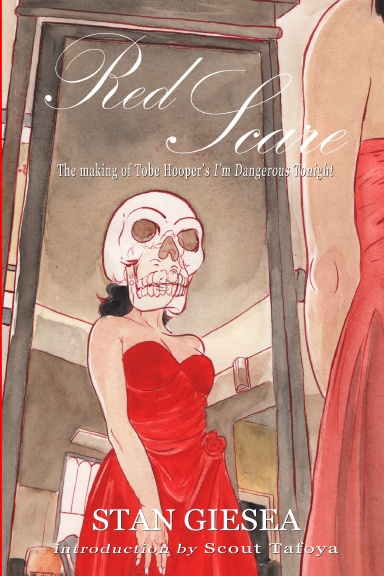
RED SCARE: THE MAKING OF TOBE HOOPER'S I'M DANGEROUS TONIGHT

The resident Hooper storyteller is back with a book about the film on everyone's tongues, I'm Dangerous Tonight!

We all know Hooper was an idiosyncratic guy, one who earned the affection and raised the ire of the many whose paths the man crossed. But have you ever wondered where'd you fall if you were on one of his sets? Take the virtual mind's-eye tour with this very special book by wordsmith Stan Giesea, with introduction by savant of ideas and polemics, the incomparable Scout Tafoya, with artwork by artist (and filmmaker) Patrick Horvath.

Support independent writers and buy it on Lulu. I've read it, it's worth it, and it's a lovely tribute to an artist we love!

BUY IT HERE


Saturday, December 18, 2021

SMOLDERING EMBERS


Buy it now! A rare perspective of, so far as my estimation goes, one of the most important acts of putting to film in the history of the art form.  Chock full of goodies, it is a chronicle of the making of Tobe Hooper's Spontaneous Combustion, no longer worthy of the subtitle "a folly in the making," and so can be classified in the proper library section of a celebration, one about one's relationship to an act of creation.  A natural part of the Spontaneous Combustion extended half-life, an impossibility of atoms reserved only for great artists and genuine enigmas, how Stan possibly could have known is a question for him (and which you may possibly find an answer in the book)!

Friday, December 17, 2021

Review of 'American Twilight' by Thomas Puhr

    "We're all just victims of the times."

(The character of Pam in the original shooting script of 'The Texas
Chain Saw Massacre')

In lieu of my own (unwritten) rundown of the new American Twilight collection of essays, I'm grateful someone else has taken it upon themselves to provide an intended overview of the book and demonstrate the breadth of both: a) the spectrum of pieces themselves, and b) what they reveal of Hooper's filmography: that, while clear now after bated time, the breadth of the works together has always been a vital continuum, duly, and first, showing us how one can meld artistic expression, current trends, and an osmosis of societal factors, and then, second, patiently waiting for its time that it can make its most needful impact.

'The House That Hooper Built - American Twilight: The Cinema of Tobe Hooper,' review by Thomas Puhr

American Twilight shows a group of people being willing to put the work in to advance an unusual but important perspective, and I for one, who is not an academic by any means, hope to advance it myself in ways that hopefully do not suffer from my lack of a formal discipline.  For now, we have the acceptance that this is a conversation between multiple people that is worth having.

Monday, November 29, 2021

We're Still Talking

Thanks to Joe Bob Briggs for the pomp, circumstance, and know-how.  That is a man for whom reasoned expertise is second nature.  University of Texas Press and the "American Twilight" editors took the momentum to graciously invite the speakers from the Joe Bob Briggs event back to cover things more in-depth.

(Above) Scout Tafoya leads a far-reaching conversation full of allusions with "American Twilight" editor Will Dodson that covers all of Hooper's marginalized TV work and the politics of distrust and paranoia subsumed into all of them, not as a sharpened or pointed political sling (often manifested as satire in those outside works) but as a general malaise of anger and rebellion.  The Bush presidential cabinet is a particular target for Hooper's, and the participants', disdain.

(Above) First-hand observer of Hooper's working methods Stan Giesea and someone who looks an awful lot like myself provide, with the help of moderating presence Dr. Will Dodson, PhD, a more focused, smaller-in-scope discussion on ideas barely formed and secrets unlocked, but put forth in the shape Hooper scholarship has so far taken, which is theses, manifestos, and histories yet to be written.  "American Twilight" is of course the ideal of where scholarship can go, but we show how a live Hooper seminar might play in the future after a few speech lessons and public speaking tutorials.


(Above) Co-editors Kristopher Woofter, PhD. and Will Dodson, PhD. discuss the themes running through their writers' essays and get surprisingly passionate about underrated Hooper films from The Funhouse  to Crocodile and Mortuary.  Getting matter-of-fact about Poltergeist is the evolution of Hooper discourse.

Saturday, October 16, 2021

References for AMERICAN TWILIGHT Livestream Event (With Joe Bob Briggs)

Invaders from Mars Rough Cut (Raw)

John 'Bud' Cardos's and Tobe Hooper's and Julius Banzon's The Dark Re-cut

Anatomizing 'The Dark' - Long article on The Dark

The Dark Twitter - Where it is revealed Hooper's early shooting work on the film took place largely in Karen Black's home as a location!  Karen Black must have been a longtime acquaintance, as she was then married to his future Texas Chainsaw Massacre 2 screenwriter and fellow Texan L.M. Kit Carson. 

Thursday, October 14, 2021

SPONTANEOUS COMBUSTION: THE ROUGH CUT RECONSTRUCTION (V.1)

A glimpse into what could have been.

It is by and large the same film.

Hooper is no editor.

But this is the Spontaneous Combustion as borderless genre soap opera he imagined.

Kiyoshi Kurosawa went on to make similar films, predominantly the monstrous romances, with Loft and Daguerrotype.

(Unfortunately, YouTube has flagged the video for copyright reasons from being viewable in essentially all territories outside the US. If you are an international viewer and would like to watch this reconstruction cut, please reply or message me directly.)


Thursday, September 16, 2021

"American Twilight" Excerpt: Final Chapter, "Tobe Hooper and the American Twilight" (Christopher Sharrett)

 (Click-through to read)


"My point is that Hooper, like these other men, was constrained by money, his greatness hampered by money issues – although his first masterpiece was as low-rent as one could imagine. Still, that kind of cinema, with its intelligence and wit, may thrive precisely because of its status in its day, a “poverty row” piece of lowbrow drivel never to be taken seriously except by a few nuts who like to overthink such things. 
 

(...)
 
Hooper was as aware of the end of the American utopian aspiration as Romero, his greatest colleague. His ability to realize fully all of his visions was more limited than Romero’s, but what he did achieve is remarkable."

Sharrett, 2021

Wednesday, September 15, 2021

"American Twilight" Excerpt: Introduction

 (Click-through to read)


"The Song Is Love, named after the 1967 song by the trio, is an inspired combination of political documentary and experimental portraiture, organized around personal statements by each band member. Mixing performance footage with candid interviews, musings by the band members in nature and backstage, and footage of the members marching and speaking at political rallies, the film is a meditation on America’s troubled politics, at home and abroad. Interviewed about the film, Hooper averred, “It’s not a documentary, […] and it’s not necessarily ABOUT Peter, Paul and Mary, although they are featured in it” (quoted in Worley 1970).
 

Several candid moments serve as structuring set pieces, in which the three artists discuss freedom of artistic expression, and the political limitations on that freedom. Hooper parallels these intimate statements with the band members’ more public-facing protests for equal rights.
 

(...)
 

Such feelings about the freedom and power of art against the expectations of the industry seem portentously relevant to Hooper’s own career, since the director was politically and artistically second-guessed at every turn. Though Hooper could not have predicted his future struggles inside and outside the Hollywood juggernaut, he fashioned a documentary that consciously blended the politics of freedom and equality with investigations of free artistic self-expression under stress."

Woofter/Dodson, 2021

Tuesday, September 14, 2021

IT'S COMING. IT'S HERE.


The first academic collection of essays devoted to Tobe Hooper's career - entitled American Twilight: The Cinema of Tobe Hooper - has finally been curated and assembled by editors Kristopher Woofter and Will Dodson (who contribute their own essays within the book) and released by the University of Texas Press publishing outfit.

Released in June 2021, it is still fresh in the minds of its readers and non-readers (I am lucky to have counted myself in the former group since May, after receiving an early copy in the mail, a real moment of hope and beauty in difficult times) and nonpareil in its in-depth analyses and contributions to a scholasticism of a marginal career and what Hooper means to the landscape of genre.  Promotions are planned and it is an illustrious initiation to upcoming Hooper releases, such as I'm Dangerous Tonight coming to Blu-Ray from Kino Lorber, a possible Poltergeist 4K release for its 40th Anniversary, and a book on the making of Spontaneous Combustion by writer Stan Giesea.

For information and purchasing options: UTPress Book Listing / Amazon / Kindle

Sunday, April 11, 2021

NEW HOOPER BOOK: CINEMAPHAGY by Scout Tafoya

So I've pored over and thoroughly imbibed the rich offerings of critic/author/filmmaker/loyal Hooper acolyte Scout Tafoya's new offering in Tobe Hooper scholasticism (buy it online at most booksellers, digital copy also available on Amazon Kindle), and took in his many insights which hit like lightning strikes within Tafoya's oddly business-minded but nonetheless voluminous prose, but his after-release postmortems for various publicity blogs may include the clearest declarations of intent and most candid and impassioned statements on the schisms of perception when it comes to what Hooper was doing and what only he was ever allowed to do in his career pocked by circumstances:

"As in Mortuary, Hooper saw the GOP infecting the people, the land, the sky, everything it touched with its “good old days”.  Rhetoric of a return to norms while the flesh was melted off the bones of their opponents – foreign policy at least as old as the Vietnam war he none too subtly opposes in both Eggshells, his study of a Texas commune, and The Song is Love, his concert doc featuring a show stopping performance from the unlikely likes of Peter, Paul, and Mary." 
http://www.dosomedamage.com/2021/03/scout-tafoya-on-films-of-tobe-hooper.html

"All that rich text just sitting there. That was why I wanted to write Cinemaphagy. Class and money are still such silent but heavy forces in cinema studies. You lose money and you’re off the cultural radar. Look at Michael Cimino. Everyone talks about Deer Hunter (1978), no one talks about Desperate Hours (1990). Just how it goes. You fuck with a producer’s bottom line and the critical establishment is only too happy to do the moneymen the favor of burying them. Hooper was hidden real good. Only his friends could see where they buried him, and they’d occasionally give him work but his reputation never grew past The Texas Chain Saw Massacre (1974). Even now it’s tough to get people to take him seriously."
https://frame.land/hooper-dreams-why-i-wrote-cinemaphagy/

Saturday, April 10, 2021

Odds & Ends, Yet Again

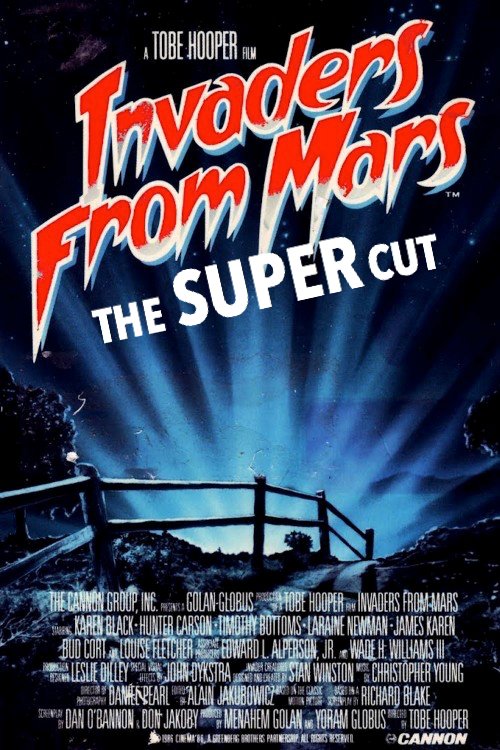
Experience Tobe Hooper's Invaders from Mars in a new way.  An experimental one-to-one fusion of the theatrical version and the VHS-ripped rough cut that has made its way online here, this is hypothetical in many ways and something actually quite personal in others (the sharp-eyed fans of the film in its original form may notice a completely gratuitous cut made without any precipitation in the latter half of the film, and this was made only to exert some sort of power and predominance over the film, better to not confuse it for anything authorized or completely anyone's vision but my own - to the extent whatever that means).

It can ultimately be said that the best way to experience either Invaders from Mars or its rough cut are separately, as the rough cut gains (and earns) a quiet beauty by being raw and unmediated by post-production sound mixing and scoring, while the logy and lumpy pacing of Invaders from Mars by nature - one will notice, especially from watching the rough cut, that it's the rare Hooper feature that takes place explicitly over multiple days, laying out clearly its methodical passage of time (something I eventually argue is a thematic and philosophic point of the film) - becomes even more enervating when accommodating for the switching media.

I recommend all give it a chance, though, as it shows a film that was the original intent and that seemed to have had better grasp of the roiling ideas contained within it.

Watch it here: https://www.youtube.com/watch?v=S4USz5Whrq4

ACCOMPANYING TEXT TO 'INVADERS FROM MARS: THE SUPER CUT'

This is an unofficial experimental supercut combining Tobe Hooper's extant rough cut of the first hour and 19 minutes of the film and the full theatrical cut released by Cannon Films. The rough cut footage was taken from a VHS duplication of the director's in-progress cut, and thus reflects the video quality of the source. Rather than try to simply reinstate the larger deleted or altered sequences back into the movie in chunks, I frame by frame matched the two cuts and reconstructed every instinctual editing choice made in the rough cut phase, which ranged from the substantial to the miniscule. This was in order to present as closely as possible a "What Could Have Been" cut, that is, as if Hooper's initial desire of what his film would be actually made it to the screen.

Big thank you to those who've supported, cheerleaded, and those who viewed my initial demo of the film. Explicitly personal touches were added that one may or may not notice (the most suggestive of "creative liberties" more often than not involved sound work and musical choices). Acknowledgements to filmmaker Christofer Pallu for mostly suggesting to add sound effects for the outdoor radar device and the bold, cosmetic statement to chromakey Hooper's credit over the shot of the house, but also for his enthusiasm for the project and audio editing advice.

The frame by frame matching was actually a more necessary and complicated process than one would think, as the final cut exhibited not only deletions, but chronological reediting and swapped takes. Thus, take the following into consideration:

* scenes existing in the final film will appear here but in rough cut quality. This is most likely because entirely alternate takes were used in place of those initially incorporated.
* Shots may have been used in the final cut but utilized in a different capacity or at a different point. Thus, a "clean" final cut shot will be used momentarily within a scene that is by and large non-existent in the final cut.
* Scenes were restructured back to the original ordering and chronology of Hooper's rough cut.
* This is not even to bring up the scoring and sound work. The "personal" and "experimental" side comes up here, with musical workarounds used to change the tone of the film in the way I felt would have been closer to Hooper's primary intentions. The most glaring example would be the replacement of the opening credits theme used in the final cut with what is listed on the film's original soundtrack as "Original Intro and Main Title." In the process of constructing, it was discovered the cue known as "Original Intro and Main Title" was simply displaced, being not used in the opening titles, placed over the scene in which the parents put David to bed in its entirety as a soft, catch-all underscoring. Feeling this was an artificial rendering of the scene resultant of a utilitarian mindset - "if you got it/paid for it, use it" - and a desire to make the film play smoother, I used the rough cut audio in order to go without the scoring. Use of various cues from the original soundtrack recording is also done on occasion, particularly difficult as Christopher Young's score itself was subject to a similar sort of gutting, the film essentially scored twice - once by Young, a second pass, one of synthesizer atmospherics, by David Storrs - and so parsing what made it into the film and what didn't remains, even for me, after poring through the film for the last three months, incredibly difficult.

You can view the raw rough cut footage - before I tried to conform it to some level of theatrical presentation - or enjoy the Rough Cut as its own whole piece here: youtube.com/watch?v=S8JWWVOh91A&t=124s

A statement on the rough cut:

"... Clearer intentions are found in the more fragmented editing...

The rocket destruction scene is symptomatically reconstructed into a slack, Cannon spectacle in the Cannon cut... [which] eliminates dialogue and re-chronologizes the sequence... whereas here it's a fragmentary confusion of splintered world-views.

In its clearer demonstration of David as our proletariat hero... in its bolder assertion of time in the face of illusionary, dreamed spectacle, we see what Hooper truly intended. The intentions and placidity of the rough cut make are undeniably superior."

—————————————————————

Also included at my Vimeo is my 2020 recut of The Dark, directed by John 'Bud' Cardos, but with "contributions" by Tobe Hooper.  It is one of my favorite films, and was even more of a labor of love than the Invaders from Mars recut.  It removed all post-production tampering by the producers to turn it into an alien sci-fi film rather than the supernatural thriller it was intended to be.

"This re-cut of John 'Bud' Cardos's THE DARK involves no commercial interest, but, under fair use law, it does wish to rip the film away from the historic avarice of its producers and reclaim a vision that was much stronger than their misappropriation could ever be. So this isn't just for education, either - this is fair use under criticism/comment that involves piracy and smuggling, the only proper response to its producers... one of who, Edward L. Montoro, is actually a literal crook, absconding with an embezzled fortune to an equatorial region in the early 80s to never be heard from again.

"THE DARK: RECUT is not only a proper excising of studio/producer impositions but also partly a historical record of THE DARK, in particular, Tobe Hooper's role in it."

[End excerpt]"

"In the tradition of RAISING CAIN RE-CUT, THE DARK RE-CUT (2020) aims to restore the original integrity behind a film that some love, most simply have no thoughts about at all. But it’s the principle of the thing. In the year between THE DARK’s filming and its release in January 1979, producers, anticipating the release of Ridley Scott’s ALIEN and noticing the increasing popularity of “space” films from STARS WARS to CLOSE ENCOUNTERS, decided to turn what was a creature feature (one involving a monstrous entity stalking the LA streets and committing a murder every night, a monster of which our inability to explain was the very point of the original story) into a space invader flick, reediting every murder into an attack by an eye-laser-shooting alien using cheap opticals and superimposed stock explosions. Reshoots occurred to implement actual fire effects into the big monster showdown in the end, beginning and end titles imploring of the vastness of space were added, and the rest is history. In the end, even John ‘Bud’ Cardos, who didn’t even develop or work on the preproduction of the film - rather, it was developed by Tobe Hooper himself - was caught off-guard by this imposition by the producers. THE DARK (1979) is a rich text concerning the coexistence of clashing egos, the workings of civil society as a tapestry meant to function as a whole, the illusion of state protection, the nature of fear as a natural outgrowth of social constructs, and the idea of darkness as what hides yet contains that which we fear, so much as being a reminder of a state pre-consciousness and pre-society. This may not all come to fruition in the film that was ultimately removed from Tobe Hooper’s hands, but what remains or is sensed of his and John ‘Bud’ Cardos’s efforts deserves at least the saving from one of the most cynical and scornful moves in producership history.

THE DARK: RECUT is not only a proper excising of studio/producer impositions but also partly a historical record of THE DARK, in particular, Tobe Hooper's role in it.”

The Dark Re-Cut

Follow the Facebook page

Odds & Ends

Some capsule reviews I've written in the meantime of Hooper's films.  Presented in rough chronology, so the repeating of titles and autobiographical elements within the reviews creates an interesting semi-narrative.

THE FUNHOUSE

Many great horror films are war films, in that they're about two opposing parties facing off in ideological or existential opposition. This is the greatest horror-battle film, half the parties unaware they represent a side in a war and that their actions and strategy (or non-strategy) are outright effecting the fate of their respective brothers-in-arms. The subtext is made into the text, which is the subtext, and this is through seeing these structures while the characters never do. The sound design is the ultimate piece completing the Gesamtkunstwerk here (and this should be played loud), as background dialogue, whispered back-and-forth, and repeated whimpers fill out the ever-strategizing, ever-blinkering, of an eternal war.

THE TEXAS CHAIN SAW MASSACRE

This is not a film of exposition, but more a series of scenic warning signs. There is no attempt to create a comprehensive view of our characters and we do not get to know them, they are merely the human figures in a film made up of cautionary events, conceived in Hooper and Henkel's liberally-dispersed and more writerly gestures, incarnate in Hooper's deliberate invention that determines gesture as just that. So extreme are its depictions of irrational terror and social entropy that it forgoes its claims to naturalism early on, tapping into underlying structures and artful syncopation that work on you at a subconscious level, much like a fairy-tale that knows what information to give out and what of its story to truncate and remix. Sally running into a branch leading to an extended moment of disorientation is the point at which the film no longer seems to wish to hide its claims to artifice. Like Hooper's double-window-jumping, the branch is clearly contrived, not to throw an extra jolt in but to support the three-pronged journey Sally embarks on (once her and Franklin enter the woods), acting as a final consecrating indignity - one at a final station of the cross - before the plot can move forward. Only Hooper can make a chaotic chase through a nettled copse geographically and structurally coherent, and Hooper does this because he has established the old Franklin house, he's established the Sawyer house - Sally's journey within it, itself, is an up-down-up structured movement - he establishes the gas station (using incredible tracking shots), and he never introduced that branch. I also noted the "humor" of the scene where Sally is finally brought into the Sawyer house as a captive, of which Hooper has often expressed feeling disappointed when audiences would be too terrified to catch on to that humor. It is less outright humor, though, than it is the sharpness of his editing and the rhythm he finds in the three cannibals' interactions, and I think Hooper knew this. He was not making a comedy, but he was making a hyper-observant portrait of inter-social behavior. The dinner scene is the apex of all of Hooper's ideas of the death-image, but he also shows remarkable dramatic continuity even amidst the chaos. I like how Leatherface is often quite peripheral in the scene, and it is only when Sally is not explicitly facing off with the Hitch-Hiker, who engages her the most directly and the most cruelly, providing the bulk of the drama in the scene, that Leatherface finally gets his moment with a repeat motion, silently creeping toward Sally, a curious hulk seen only through Sally's craning POV. 

THE TEXAS CHAINSAW MASSACRE 2

Feels rushed in the making, but if L.G.’s holy-coded denouement and Jesus arc doesn’t suggest simply another Tobe Hooper passion play, then I’m moved for nothing.

POLTERGEIST

100% Hooper. Spielberg would never make this awkward, slow, imagistic, and bogged-down-by-images (and pauses, and rhythmic digressions) of a film. The story and script are nonsense, this is merely an experiment in narrative storytelling. Spielberg's pretense of narrative through an emotive frivolity is undone by Hooper's seriousness with everything that juxtaposes unnaturalness in supposedly prescribed relationships. Alternately, Spielberg allows Hooper to divest himself of all his worries about the make-up of the family. Imagine Poltergeist without the kidnapping, its inciting, heroism-precipitating incident, and you would be close to Hooper's original conception of Poltergeist: a family lives next to a cemetery, small nuisance-like poltergeist activity occurs, and it ends in a chaotic finale in which a hidden history reveals itself in wagon wheels emerging from the mud. In the first act you feel the traces of this film. The story is told through magic tricks with the camera, not the coherence of the plot - the chair stacking is something you would see right out of Hooper’s Eggshells. Even after the imposition of narrative stakes, the film is a structureless procession of narrative stoppages, filled with pauses and performative silences (just think of the final shot). Hooper makes a set-piece even of a parents’ joint session, Hooper being the only one who can stage believably the rambling of two high individuals and in this realism, create a unified set piece out of a duet of performances. This is filled with visually-stimulated nothing-stretches; shorthand narrative; long form situationism. Hooper’s capacity for reframing is something he shares with Kiyoshi Kurosawa, a form of storytelling that is not in the content on the surface, not the telling of story (no matter how much they protest that idea), but framing and then subtle reframing, mining an always-drama, an always-characterization, in the very manner in which a story is told, or more accurately, an existence is circumscribed. Every Spielberg trope - the foreground-background placement, the one take, even the camera push into faces of awe - is noticeably different from Spielberg’s usage in the inseparable context of Hooper’s creation of imagist set-pieces, divorcing these techniques from narrative, embedding it in Hooper’s awkward handcraft, his naturalist set-piecing. It is most satisfying as a Frankenstein creature, a film not to have a soul of its own, but to mock the idea of life by the brazen networking of its parts. As a narrative, it is an ungainly creature, but as Hooper’s dissociated networking of parts, it is a comment on the acute sentience of his creation nevertheless. Tangina’s very long debriefing on "the Beast" is not in the original script. What neuronal mishap of elongating this film’s anti-plot was it that provoked that rewrite? 

TOOLBOX MURDERS

It might be cliche for me to reevaluate a Hooper film and inevitably give it a higher rating, but Toolbox Murders is as pure and uncluttered, unproblematic, an expression of Hooper's long, novelistic game as anything. The screening was preceded by outpourings of fondness, gratefulness, and admiration for the infinitely disarming, idiosyncratic, and eccentric Hooper: I heard Danny Pearl express his gratefulness for being given his career, Amanda Plummer in awe of a man she had cherished (telling the story of Kiyoshi Kurosawa and Tobe Hooper deep in an exchange upon meeting - as he was loved by all the Japanese genre filmmakers - and realizing the two men looked identical), Toolbox AD Andrew Zimmerman speak of Hooper's down-home sagacity shooting in the tricky Ambassador Hotel and the "magic" inevitable on a Hooper set. Mr. and Mrs. Ernest Dickerson, his dearest confidantes, who looked on him like a child, Tom Holland bloviating endearingly about his quirks in their Autumn friendship and his coming over with a copy of Djinn and pouring over every frame with them, Mick Garris bowing out on a brief Poltergeist flare-up when overcome with feelings, but recommending everyone just listen to the podcast episode he did that broached the subject as he was there and saw it all. Toolbox Murders in 35mm and theatrical sound (who knew the score was so meticulous and constant?) is definitely giving it the respect it deserves. It may move like an Argento or Polanski film, give or take, but in 35mm it looks and feels more like Hooper's Tsai Ming-Liang film. I report this in a journalistic capacity, not as an impinging on the personal stories of those closest to him. This is for posterity and the record. 

EATEN ALIVE

"As I heard the story in the paper the next day... my tears came tumbling down." 

"What do you want me to do? Throw myself to the alligators?" 

Yes, this movie answers, that is what most men want women to do, as embodied by William Finley's emotionally erratic pater familias. 

"I said git and git. I made the signal. I told ya and I told ya and I told ya. You come in here and you go in there, ruttin' and ruttin'. You think I don't know?" 

Blistering. Also, contrary to how it may come off at first, carefully considered (as "adapted for the screen" by Kim Henkel), despite the limitations of its making. The events of the film ensue because the monkey (and all its primate functions) dies, and only the reptile Id is left. This may not reach the intensity and razor intelligence of Texas Chain Saw Massacre, but this is because it is an entirely different animal: a studio picture, a work of fantasy, a lush piece of theater and a melodrama filled with emotions and sentiment (to the degree such a compromised work of grindhouse filmmaking can) - not a cunningly pointed piece of faux-guerilla filmmaking. Yet these are two films united by the ferocity and vision of their artist (and their shared look at madness), two very different projects finding overlap simply in the youthful inspiration and joie de vivre of their hard-working creator: works put together by an artisanal hand, as if by the skin of their teeth, for each cut and each moment of dramatic montage is welded into the thing as if its life depended on it. Hooper's hybridizing of studio-set artifice and the expressionistic run-and-gun inspiration of his previous film is truly something to marvel at, for we get the expressive cynicism of 'Chain Saw' tied to the mournful, non-cynical gestures of melodrama. Melodrama, at least in its most sophisticated form, has always been a genre of intense detail, and Eaten Alive provides it in gently preponderant ways: a preponderance of arresting subplots, for instance Libby Wood's lovelorn projection onto Stuart Whitman's sheriff no clearer than today with Crystin Sinclair's performance writ large in 35mm; the blood-smudged side of the veranda where Judd's mopping would be less effective, lying just below a clueless Buck's line of sight before he becomes croc bait; the evolution of victims, from Roy to Harvey Wood to Buck, all a lineage of masculinity, but Harvey's stoicism and Buck's belligerence and sexual odiousness alleviated by their growing rational awareness of the imperiled child underneath, each acting more humanly just as Judd ratchets up in villainy and madness. Quoted above is Judd's menacing exhortations to a distracted Buck, as he tries to locate the sounds of the little girl below, and it is a collection of phrases Judd has said at various prior points in the film. This moment is the condensation of Judd's mania, the novel serial killer who has no motivation but to reflect the victim's status right back at them, as refracted through an opaque glass (that is Judd) of PTSD, sexual neurosis, an unchecked sort of libertarianism (distrust of authority), and retrograde barbarity. He circles behind Buck in three paces, spouting these toxic Tantra, warnings to Buck and self-pity for himself. All of it results in anger. The film's details go on, and accumulate, combined in a film that is almost as immersive and in control as Texas Chain Saw Massacre, and that is the sign of a filmmaker who would never stop crafting his work (until it was taken away from him). Even the cramped chase sequences with Angie under the floorboards are more than meets the eye, slyly crafted bravura bouts of impressionist suspense. I love how it ends its playlist of radio songs - up to that point pure American Countrypolitan - with a Spanish Mariachi song. Suffering is a universal language. Vixen Lynette saves the day. Judd's demise is a triumphant end to a work of clear structure. 

POLTERGEIST

This kind of sucks in supersized 35mm. The film is returned back to its commercial purposes, its sensory overload context, every shot no longer a rarefied decision but simply what needed to be shot to get a film up on the screen at all. The film's theology is so populist and middling. It's just like Gremlins and The Goonies, serious (to varying degrees) filmmakers trying their best to cohere (or, better yet, "incohere") committee-written pop nonsense. The goth nonsense here curdles when mysterious strings accompany the reveal that you are, in fact, living on top of a cemetery. The mechanics of the production show their extreme laboriousness, every close-up surely its own hurdle while Goldsmith’s score is simply used to cover-up Hooper’s quick work and inattention to detail. It's a testament to Hooper's wayward train, which this certainly is - read the script, look at the preliminary storyboards, and see a film barely going by plan - that the experience of going to see the "new Spielberg production" feels less like a visit to the toy store and more like getting trapped in a toy store elevator for two hours with one genuine mystic and one ad man. Saying Spielberg was entirely happy with what ended up on the screen is akin to Hollywood revisionism, where Spielberg-hype fantasy overtakes a grim, frankly sloppy reality ("Can't we 'zazz this up a bit, Tobe?" "No Steven, just shoot it in wide shots, your energy tires me.")... Viewed in 35mm right in the center of Tinsel Town, call the experience, and it was kind of like traveling back in time, ONCE UPON A TIME IN HOOPERWOOD. 

EATEN ALIVE

"It's much more complex than it seems. I tried to establish some kind of motif that carries throughout the show - sometimes that's actually more important than what you're actually showing. This has a lot to do with lights and shadows: it takes place in a single night, from dusk to dawn. And all the characters bring with them some sort of history, they're not just cardboard characters walking into a slaughterhouse." - Tobe Hooper

I'm no longer convinced of its formal elements, a little too diluted by cinematographer Caramico's hastiness, a little too unfixed on Hooper's fixation on lamps as indifferent beacons of our everyday living, and on decoration (his interest hardly allowed to let flourish until Poltergeist); a little too, dare I venture the idea, slick in its horrific and atmospheric affects - the roiling fog, the canted Freudian insert-shots that glimpse the gator, and so on and so forth. There is a cohesive design and digestible shape here that gets in the way of the film of pure suggestion I have touted. But the film has ceased to become a rational object of evaluation for me, instead it has become a series of accidents and incremental details, and a spirit that defies my increased scrutiny with every revisit (Why didn't he center this shot better? Why didn't he move on this one? Why didn't he hold on this shot longer? It is the peril of being the aficionado), defies the bourgeoisie comfort blanket of hard "decisions" being always, constantly, made. This is a film of suggestion, because I am no longer in charge of the effect it has on me, even as I criticize it. The affective discharge I get in my synapses when I hear the mariachi song that closes the film is ten times greater than the lack of a point in certain prior shots, or the mechanics it may indulge in. This is a film of melancholy, even as it never makes a point of its melancholy. Remember that film Babel? This has the effect that that film desperately wants to achieve (about melancholy and interconnectivity) through constant making a point of it. I'd rather not know what I'm heading into, and this is the magic of Hooper's sense of cinema.

POLTERGEIST

No discernible thematic center, but still a strange, untangled object made of so much hobbled-together uncanny parts, set in a house that doesn't look like a house but a studio set and may be the last hold-out of studio soundstage artifice in a film that wasn't outwardly trying to create such the effect (such as One From the Heart). The ghostly woman descending the stairs is a leading example of a scene that was forced into cohesion, filmed without an idea of what was actually coming down the stairs. Hooper filmed it any which way and may have removed all purpose from the scene. The characters stare at it and it disappears (no one screams like in the script); a true scene that defies sense. Hooper only cared about the image (a wide shot of the living room, characters dispersed into all four corners, the top of the stairs and a hanging lamplight) and it was hobbled into cohesion at a later date with the filming of the ghost (and its equally unhelpful video capture). Defying pragmatic usage, it is not suspenseful, nor consequential, nor particularly elaborate or impressive a set-piece - those things are the domain of Spielberg - but it is emblematic of Poltergeist as a film of parts, schizophrenic and hobbled and rickety and two voices battling it out, Spielberg's sensibleness and Hooper's curiousness and openness, for the way things may not come together as a whole.

DOWN FRIDAY STREET

I try not to be too hyperbolic about a short documentary that is as shaggy, messy, thematically undefined, and unassiduously untempered aesthetically as all of Hooper’s other work, but if you are looking for that connecting thread between the curiously precise classicalist concerns of Hooper’s slapstick period piece The Heisters and the New Wave, timely-concerned vérité phase begun with Eggshells, this is the film for you. Houses Also Die, you can call it, and if it’s not in Hooper’s vocabulary to mount a discourse on race and anthropology, then we can at least expect the same introverted, phobic interests in mood, zones, the ghostly aspects of change and time; experimental techniques melded with his governing interest in the grounded aspects of a story to be told (here, of stately old WASP houses being razed for parking lots). A sharp dip into an almost-refined antiquity for a filmmaker who usually concerns himself with ardent, corrupted civilization (not “society,” as Hooper is either concerned with individuals themselves or the structure at large, at a nominal scale rather than a precise one - his observations on specific social groups often weaker than what is gathered when these subcultures merely stand in for larger issues). This is Hooper’s most withdrawn, well-bred film, into an interior world of objects; his truest occult film (a subject he would subsequently show interest in), for the objects are left to exist throughout divorced from human hands and presence (which Hooper's films of object-space idée fixe naturally betray, with characters). This is Tobe Hooper’s The Haunting of Hill House. It’s Hooper’s closest to a structuralist film, and he’s come close due to his miraculous instincts even in his narrative features. Rustic, region-specific Profit Motives and the Whispering Wind (Gianvito, 2007), give way to Michael Snow, give way to Kurosawa’s Pulse and, as mentioned, Shirley Jackson (and her antisocial libertarian, quasi-satirical takes on the commercialism running roughshod over a bygone, gothic hominess), and the seeds of hints are planted for borrowings - straight-on reiteration of techniques, a kingly lineage of fated self-plagiarism - in Eggshells, Poltergeist, and Djinn.