Showing posts with label Val Lewton. Show all posts

Thursday, September 25, 2014

Cinema Tales of Woe (A THAS Tributary)

There is a long tradition in film history of cinema works being taken away from their directors and reedited, reconfigured, rejiggered, or manhandled into something quite apart from their original form.  Ridley Scott's Blade Runner, Terry Gilliam's Brazil, perhaps Joe Dante's Explorers (rushed to release before a proper, satisfied edit could be completed).  Orson Welles is famous for his struggles against the powers-that-be of distribution, most notably the tragedy befalling Magnificent Ambersons.  This sort of thing has even happened to Akira Kurosawa and Sergei Eisenstein, so magnitude of historical greatness does not mean invulnerability to the wills of their contemporary moneylenders.

Many of these have managed to survive in critical regard, whether due to an eventual Director's Cut or simply the surviving strength of a vision running at a piece's core, bearing the marks of its contradictions to the tampering caused by behind-the-scenes machinery of test audiences, producer notes, and commercially-minded studio due-process.  A film like Mark Robson and Val Lewton's The Seventh Victim stands tall despite giving off the whiff of a script pared down to its barest bones.  There are no persistent stories of tampering involving that film, though, although there may well have been cuts.  Such is the nature of the film, that its perhaps-coerced shortfalls seem naturally tailored to its humble, poetic design.  So what we have there is a film that portends and preempts the encroachment of the money-minded suits, willing them to inconsequence by insisting on the naivety of its narrative spareness, a story and a piece of cinema conceived so purely of a poetic register that it can render itself so small and come off seemingly so impoverished such that there is no gleam-in-the-eye, salivating executive with designs for grandeur waiting patiently in the sidelines to chop away at a Great Director's offering of immense hubris (it is how Lewton maneuvered the studio with all his films: films so low-budget, so seemingly practical, no one behind-the-scenes with the simple aspirations of glamor and success would bat an eye at them).  At this time, Hitchcock and Selznick were tangling horns over their next Best Picture winner, Welles was puffing himself up to outdo Citizen Kane, and meanwhile the embittered sets of that weepie cursed masterpiece were being traded quietly into the hands of Lewton and Co. to do as they will humbly and under-the-radar. 

Those great embattled works come in different shapes, sizes, and circumstances.  Cimino's Heaven's Gate and Coppola's Apocalypse Now are gigantic productions that were pared away for pacing and thrift, but I would argue there is hardly - to speak excessively - an irretrievable loss to their essential DNA, whether as doofy war epic or social-historical wide open impressionist canvas.  Blade Runner suffered more a shake-up to its inner DNA, the old-fashioned voice-over added in at odds with Scott's thoroughly Modern Hollywood sensibility.  The idea of the New Hollywood "powerful madmen" such as Scott and Coppola and Friedkin suffering with moans under the circumstances of a surrendered final cut is a bit laughable to me.  As if their brazen work can be so "tragically" undermined when they, up to a very considerable point, already have so much control, so much commandeered ability to indulge their oversized, overtly commercial visions.  Delicate Seventh Victims they are not, which is why so much hubbub could be made over another bombastic deleted sequence or a 200-minute film being cut down to a mere 150-minute film.

Hooper's career, like Welles's, is rife with the surrendering of his films to final cuts partly to completely external from him.  Hooper's Lifeforce streamlined for pacing and quickness by its distributor TriStar, Spontaneous Combustion an unknown variable of tortuous post-production, and Djinn hidden away for two years to accommodate a reedit and additional scenes.  Hooper's works, though, are "Seventh Victims" compared to the films of his New Hollywood brethren.  They actually have something to lose if the money-minded suits stick their hands into the pot, confusing his genetically different work with those of the ballyhooed Hollywood technocrats that are his peers.

I find nothing more insidious and deleterious to aesthetic progressiveness than the place New Hollywood movies hold as works so excessive that they are the films that deserve the over-protectiveness of cinema historians, as if that excised two-million dollar set piece must be mourned for (Oh, the costliness of it!), or that one lost turn of the screw in the narrative is so essential to compliment the other narrative frippery surrounding it.  Hooper's works are Seventh Victims, delicate to the touch, but under the auspices of Hollywood delusions of grandeur (not protected by Lewton shrewdness... expected, tragically, to compete).  Films that ask no more of the studio financiers or of the worship of audiences other than respecting its deep-underneath, non-monetizable integrity.

Val Lewton figured it out, but the poetic genre film proved most abusable as a homogenized market took over the industry: the mantra of the studio towards certain properties - genre ones - became, "They hold no higher interest, higher values, or higher watermarks."  Their bar is set at zero.  Who thinks profoundly or poetically with the formula of a monster wreaking havoc over a string of victims?  Forget James Whales's Frankenstein, the rich traditional horrors of Bava and Hammer Studios, or Val Lewton's sprawlingly humanist producing oeuvre.  There is no higher thought there - so thought the producers churning out genre product in the late 70s and up.  Thus, they can be meddled with to ensure highest commercial profitability.  But, as I've said before, Hooper's interest in cinema is an interest in narrative, but by no means a commercial or a literalistic one.  It is an interest in the story as a conveyance of subtext, which is a combination of the context of drama and character with the graces of form and visual communicativeness, which must be fused through a combating of conventions of crass dramatic spectacle and excessive, novel visual entertainments in order to foster the contemplation of form and metaphor.  It is all fused together in a magical, delicate alchemy of humble drama and lofty cinematic conceit.


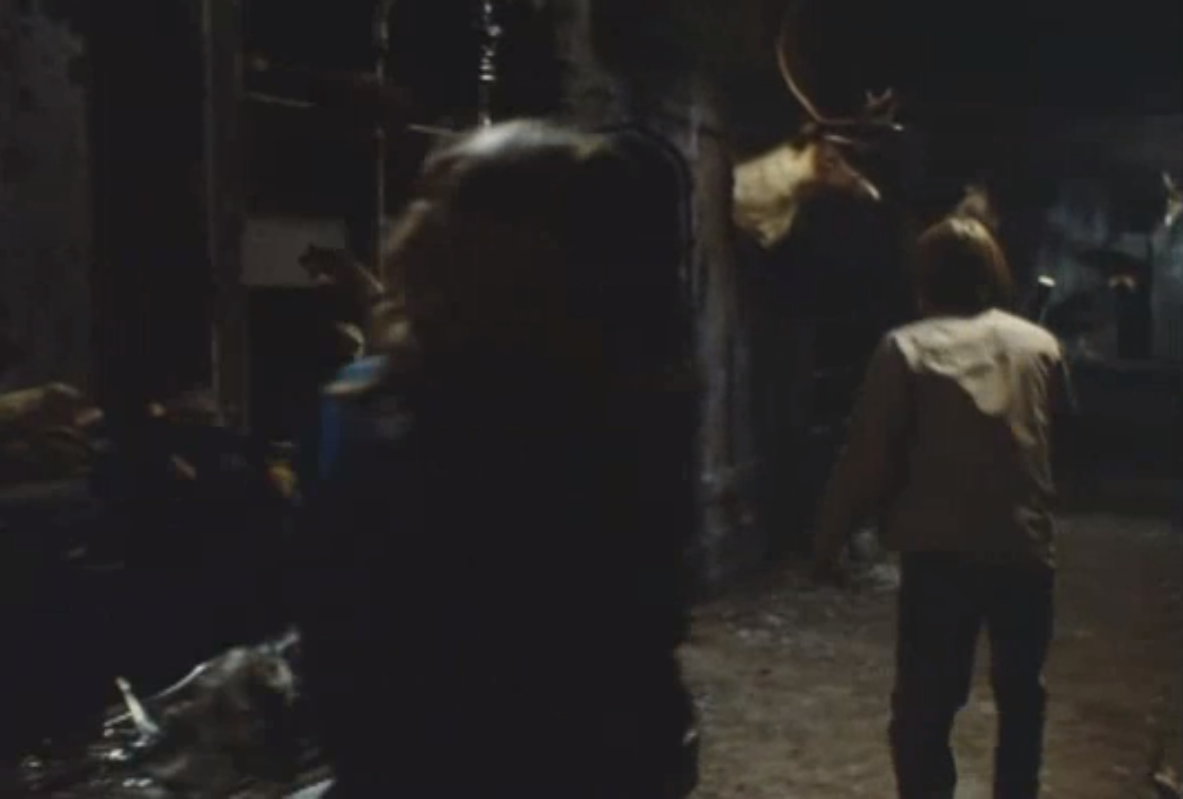
There is no more detestable an example of money-minded turpitude than what was enacted on the noteworthy work of John 'Bud' Cardos and the very talented cinematographer John Arthur Morrill (Director of Photography also for A Boy and His Dog, and who lent his services in camerawork to the 60s neo-realist triumph The Exiles, which offers a penetrating quasi-documentary eye on Native American youth in LA's Bunker Hill community) on The Dark, in which anything they could have achieved was entirely dismantled by a wish by the producers to wholly reconstruct the film as an "alien invasion" film, warping footage from its original purpose into something that entirely cheapened it and which would essentially throw in the garbage any good, creditable work done by director Cardos and his ingenious cinematographer.  No matter how much one values what is around it (I happen to value it highly), The Dark is a film literally murdered by a misbegotten attempt to do anything in their power to make this, in their eyes, "expendable" B-picture turn as much a profit as they can make it turn for them.


The snapshot above is scanned from the 1978 novelization of The Dark, written and released a year before the film was released in 1979.  In it, you can clearly see this production photo included in its pages of the filming of a character's death scene, in which apparently a large ice block was staged to fall on and crush the actor.  In the released film, this falling ice block is nowhere to be found - instead, reaction shots of the actor screaming in terror at something above him is cut together with close-ups of the monster's eyes as red laser beams are superimposed to appear as if shooting out of them.  The shot of the actor's face is then superimposed with a fireworks-like explosion to suggest the character has been blown up by the creature's laser abilities.

No matter whether the film would become "good" or remain a film lowly regarded if it were not for such tampering, such is truly horrific a case of a film and the work of its artists being totally, in one fell swoop, destroyed and, worse yet, disregarded by a thoughtless commercial imperative and uncomprehending, Porsche-driving Hollywood materialists.  Condescending to seekers of genre depth, crippling to traditions of termite art, even if the film with its integrity intact is something to be forever lost for this finite universe, the act done to The Dark may literally stand as the most vicious and unthinking thing I have ever come across in Hollywood lore.

Saturday, January 21, 2012

THAS: Hooper Trope #1: The Mathematical Scene, #1

For Hooper, a scene is not just means for narrative service, but a composition in and of itself. Many filmmakers of caliber are prized for masterminding scenes full of class-A cinematic manipulations and stylistic infusions that then fit like sleek puzzle pieces into the grander work, but no matter how stylish they get, you can sense a slavish functionality behind them, devoted to mechanizing story and sentimentalism. Hooper, on the other hand, is not devoted to story or manipulation, but to aesthetics and allegorical idea, embedded in his creation of unitary scenes of pure form, or singling moments of aesthetic creation.

Each scene its own composition, Hooper then has the uncanny ability to see a scene - and craft it - like an individual object of art, one that can hold its own allegorical essence within itself (this allegorical essence not only being its meaningfulness within the context of Hooper's often very metaphoric narratives, but the essential reason works of art have to exist: for being genuinely a product of art put forth. This quality of genuineness exudes from Hooper's careful craft, so rich with allegory-making* and so ambivalent to providing the crass satisfactions of the movies).


* Art, being notions of beauty and life expressed within a contained object, is thus in essence allegory-making (an object as a stand-in for beauty and life).

Hooper is a baroque visual jewel-maker (the constant, precise, slow-tracking elegance he asks of in his cinematography gives his scenes the luster of a jewel -- a stone shaped and cut in elaborate ornamental patterns) and a poet of cinematic narrativity (in conjunction with his films' odd metaphorical thematic frameworks), rather than a literalistic storyteller or novelty-maker. His camera eye paints scenes with a traditional brush of cinematic space and time, one motivated not just by aesthetic or dramatics, but also by an inherently cerebral allegorizing of themes and tone that is embedded in his visual design.

One good place to pinpoint this is in a recurring Hooper trope I call the "mathematical scene." These are scenes where, one can sense, the whole purpose of the scene is to be contained in whatever number of shots it consists of, which is by virtue very minimal (i.e. unconcerned with ambivalent coverage), all the way to being single shots (single shots being something Hooper does very often, a topic I will cover in the future).

They are mathematical in the sense that the scene functions as a clear summing of these concise series of shots, and more so, the produced total is not merely a scene animatedly directed, but a scene that ends up containing that essence of allegory within it - that is, it will embody the underlying tonal subtext(s) of the scene, contained wholly in this "unit of a scene," this unit consisting of the very deliberately woven sequence of shots. Usually resulting is a striking interior structure to sequences, bolstering their painterly intents and allegorical core of thematic or emotional expression ("expression" suggesting the ideas and substance which the piece of art itself wishes to communicate, not the emotional manipulations or empty visual stimuli it carries out clearly as designs on the audience).

Examples. One can usually see Hooper's sense of interior sequence structure throughout his films, even in the least conceptualized stretches, but here are particular scenes that really make a point of their isolated communicative purpose, and consist of only 1 to 5 shots (or shot set-ups), emphasizing the mathematical scene's antithesis to messy or crassly delineating, straight-forward coverage, and instead its accordance to a lyrical minimalism and unitary compactness.

#1 - Hooper Trope - The Mathematical Scene, #1 (6 Examples)

* Pluses inserted where new camera set-ups are introduced.

~1~
(from 'Poltergeist')

Scene:
Steven Freeling states his case to the paranormal investigators.


+ (2/2)


This whole scene consists of simply two slow dolly shots, in clear rhyme with each other: the first embodying the idea of a man laid out bare and despairingly anonymous (his back being fixedly to us) to a group of strange interrogators (the camera pushes in past Steven Freeling's back, and eventually lands and stops fully on Dr. Lesh). The second (the full realization of the man with his back turned), the view comes in from a wholly different direction (booming down from above, revealing his face, brilliantly left concealed initially by a lifeless room object), which signifies extreme personal stakes, as he makes utterly clear his desperation and need to get his daughter back.

Less important is the emotional sentiment than the fact that sentiment is embodied in a pairing (a summing, an equation) of camera movement, rigorous in the two shots' rhythmic arithmetic, fully divulging of formal design in its plain and wholly simple mathematical rigidity.

~2~ 
(from 'Poltergeist') 

Scene: Steven Freeling and boss Teague venture out to the hilltop cemetery to discuss the planned housing expansion.


+ (2/5)


+ (3/5)


+ (4/5)

+ (5/5)


This is another entire scene, constructed of only five shots. Hooper's directing and staging is always a mannered flow, or complex web, of directionality (another topic for a future post), and here, directionality comes to characterize a scene of moral quandary and malaise: Steven and Teague's discussion of the expansion of their real estate is treated as a left to right movement, then an end-capping back to front movement, on a hill looming over their capitalist kingdom.

Three tracking shots - (1/5), (3/5), & (5/5) - charting their movements (the first two tracking shots - 1 & 3 - being mirrors/continuations of each other, a structural repetition of rightward tracking and moral fleeing; the last, 5, is a directional coup of a scene capper, not going left to right but now going forward towards them) are evenly separated by two intermediate shots [(2/5) & (4/5)]: one is a pan from the swinging arms of the venal property owner to the slumped shape of the disillusioned protégé, a shot cinematographically precise and editorially jarring enough to strike a note of sharp, prickly visual rhetoric -- Steven's arrival into the frame deeply ironic, the foreground/background placement perfectly composed.

The second is an eerie, picturesque landscape shot revealing the cemetery.

The final shot, (5/5), contains not one, but two Hooper tropes (to be looked at specifically in the future): one, the delayed, cued dolly movement, and two, the taste Hooper has for having his characters reorient themselves in very angular ways within a continuous shot, often in ways either balletic in choreography or jarring in their defiance of conventional shot progression. In this shot, we have the camera execute its slow dolly-in movement past the cross tombstone and up into a follow shot of Steven and Teague as they start to walk back downhill. They stop, though, and Steven is made to walk back up to the camera, creating stage blocking that may well have been treated to new, progressive camera shots, but instead is left, rather awkwardly (and wholly intentionally), to this single take. It is the undermining of directionality that is yet another Hooper trope, rhetorically advanced due to the subtle but incredibly strident, boldly rhetorical way it brings attention to the existence of camera perspective: the deliberate movement forward of the camera is defied by a character walking back up to it, now even closing in the proximity with the camera than initially before.

~3~
(from 'Salem's Lot')

Scene: Susan and Mark converge in the Marsten house and haplessly meet their doom.


(noise)
(noise)(noise)
(noise)


+ (2/3)


+ (3/3)


This scene - essentially consisting of our witnessing two flies being entrapped, witlessly, in the spider's web - consists of three camera set-ups, and congeals into a stunning embodiment of fear and petrification, the stiffness of nerves at near limit manifested in two bookending dynamic shots that inhabit surprise within the camera's very movements along the dolly track, and the middle shot that places Susan's fear bound in the stiffness of her body and the stiffness of a single frozen close-up, vised ruthlessly between the moving shots around it.

Directionality is present again, this scene beginning simply as dolly movement up and down a hallway (forward vs. backward, escape vs. danger, retreat vs. entrapment). This first shot is an extended single take that first follows Susan traveling down the narrow hallway, then her arriving at the end of it, where she is confronted by Mark. The shot continues, the camera re-framing the duo into a two-shot -- a veritable Bobbsey twins image of fright, as soon noises throw their glances off-screen a frightful to and fro (directionality created through mere suggestion! Extreme and pointed directional usage made a perfect allegory for diffuse fears of the unknown!). Then the camera trails forward, back down the hallway (back where it came from; backwards vs. forwards; paralysis vs. confrontation) as Mark takes on a new dynamic of resolve, committing himself to charging into a room he knows is where the monsters await him. He strikes a heroic, stupid pose. Susan is left immobile in the foreground of the shot, cutting a striking silhouetted figure of feminine beauty, feminine piteousness, and, being perfectly frank, gender-ambivalent cowardice (I would love for this to be revealed an intentional homage to the hallway scene in Mark Robson/Val Lewton's The Seventh Victim, where Kim Hunter similarly allows a male companion go to his fate down a dark hallway while the film sticks on the woman, waiting and wondering what is occurring just past their sight).

Next is the still shot already described above, of Susan and a close-up paralyzed with/in fear...

Then a return to the wider shot as Susan finally breaks free of her paralysis, the camera also breaking free of its station in order to follow her forward, into the forbidden room...

... Then the bookending final shot/camera set-up, that has Susan entering the room and Mark's unconscious body falling past the backing camera, the camera's eye falling as swiftly to the ground as Mark and Susan, in the omniscient camera's closest approximation of human surprise. Subtly into the background appears Straker (James Mason), Susan rising in terror, the camera also rising (and dollying forward, reconfiguring the whole mise en scene) with this new found opportunity to somehow mechanically manifest surprise (surprise being essentially equivalent to fear in this funhouse that is a horror film -- especially one such as mannered as Salem's Lot, a horror film about the confronting of horrors by horror fanatics, like ourselves).

~4~
 (from 'Night Terrors')

Scene: Genie calls her father, away at the dig site.


+ (2/5)

+ (3/5)


+ (4/5)


+ (5/5)


Five shot set-ups, a whole scene neatly bifurcated into two sections: the first [(1/5) to (3/5)] depicting a daughter subtly beseeching a distant father through the telephone line (consisting of numerically neat cross-cutting between the two, the follow shot of the father being one binary, the shots of the daughter being the other), the second half [(4/5) & (5/5)] pulling wide and revealing her agency and independence from the influence of her father (consisting of two linked shots that depict, first, the daughter's exit from the home, then her arrival, into the wayward grasp of a woman of pleasure).

The archeologist father strides down a track of desert and excitedly speaks of a breakthrough find, and is framed along the path he conqueringly cuts, tracked along the eager briskness of his moving forward. Steadily intercut are the shots of the daughter, Genie, coyly inquiring when he expects to return home (whilst keeping from him her recent anxieties). She is framed frozen, against a background of ambiguous space, the extreme shallow focus relegating the house behind her to crystalline blurs, the low angle configuring a circlehead window and chandelier into synecdoche for the house-of-her-father at large - suggesting, for Genie, a house not a home, but a strange dream environment of both opulent and vague, indistinct comfort.

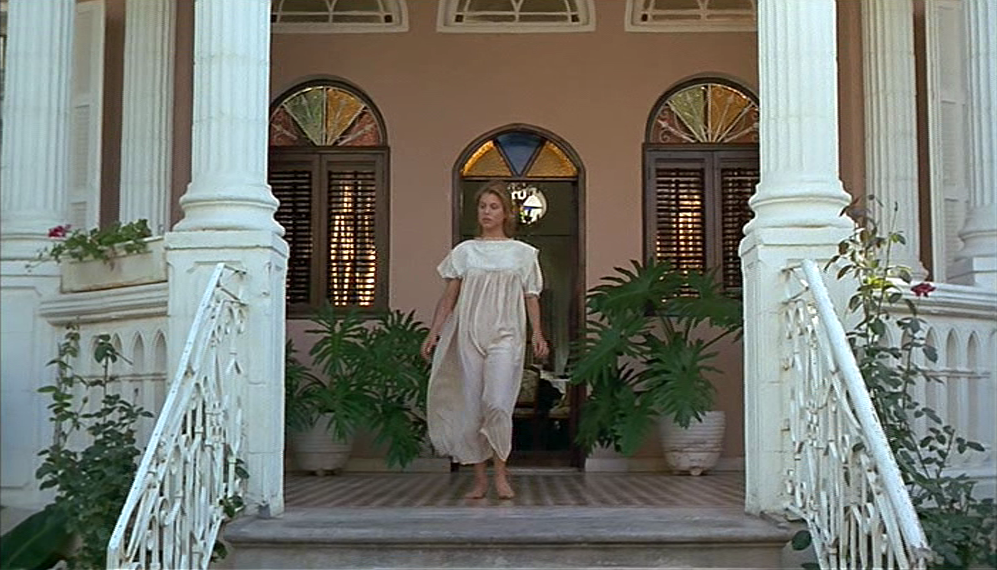
The house being the home of her dogmatic Christian father, she pushes against it even as it represents for her safety and gilded innocence and her falsely upheld "daughterhood." Finishing her capitulating "daddy's little girl" call, the camera cuts stunningly to wide just as she hangs up the telephone on the hook, signalling the start of the second half of this sequence and signifying the life she lives outside of the attachments that bind with her father. She exits the house, crossing the threshold and going down the porch steps to the patio garden, where she veers left to the waiting Sabina, a person of ideological and moral opposition to her father.

The camera simply pans with her. This moment offers very Hooperian sense of movement and lens science: the pan left creates a striking vectorial perspective (for another Hooper moment of striking vectorial subjectivity, see here) of subject proximity and lens parallax, and Hooper's expressiveness in use of metaphorical directionality pops up again in Genie's journey to the leftward reaches of the property: pure visual allegory made of a wayward daughter exiting her father's sheltering walls only to veer left to a near, yet far, garden of earthly delight.

A second shot (5/5) that beautifully matches motion (with Genie's back wiping the screen at its start) finishes off this half, as well as the whole scene: after Genie is seated, the camera begins a slow revolve in order to configure the two women into a two-shot of female symmetry, and then it holds on this symmetry as they pursue a serious, conflicting discussion on the hypocritical father who warns of sinful pleasure, and, in spite of him, the truth of the repercussions of pleasure (involving a mother who commits suicide likely due to this same father's two-faced, feckless hypocrisy).

~5~(from 'Night Terrors')
(alert: major spoiler)

Scene: Dr. Matteson is murdered while recording his latest finds.

+ (1/1)


One shot. A slow crawl closer and closer to the archeologist as he makes recorded record of his new discovery. Such display of purpose and fervor in one's work is cut cruelly and shockingly short by the sudden - yet utterly mundane - entrance of an assassin into his so-very-easily-penetrable tent.

This single, slow, elegant, time-conscious, opposite-of-excessive dolly-in shot is a brilliant encapsulation of a number of evocative items: the slow procedures of scientific endeavor (and the time-unconscious egocentricity of men with their work: this particular Christian man's utter parochialism in approaching items of an ancient religion), the suddenness, banality, and materiality of assassination, and a look at purposes at cross-purpose - a man hard at work, a killer coming and thoughtlessly cutting that short, and a camera slowly moving in towards both this man deep in his own world and a killer without regard for manners of morality, or cinema language -- whether seen as anticipated or unanticipated by the camera, the assassin outwardly evokes his audaciousness in walking brazenly towards a camera that, by convention, would be moving forward in order to push something back, not having something charge at it with such suddenness.

~6~
For Comparison: Ingmar Bergman
(from 'Through a Glass Darkly')

Scene: Martin takes his father-in-law with him to fish, where they have an intimate conversation about his wife's mental state.


+ (2/3)

+ (3/3)


A mathematical scene from outside a Hooper film. This scene from Ingmar Bergman's Through a Glass Darkly consists of three very simple camera set-ups: a wide tracking shot that follows the boat moving rightward down the lake, and two medium close-ups of the two characters inside the boat creating a shot-reverse shot sequence.

Directionality as metaphor: the characters' movement down the lake allegorizes their journey together into the uncertainties of the future.

Interior structure: the shots of the boat being rowed down the lake begin and end the scene, while a neat shot-reverse shot conversation provides the middle movement. The character rowing brings the boat to a stop in order to discuss the sensitive issue of his sick wife (the other man's sick daughter), and it is a structural evocation of a journey (shot 1... rowing along...) being needfully stalled, before it inevitably must start back up again (final shot, return to wide, back to moving).