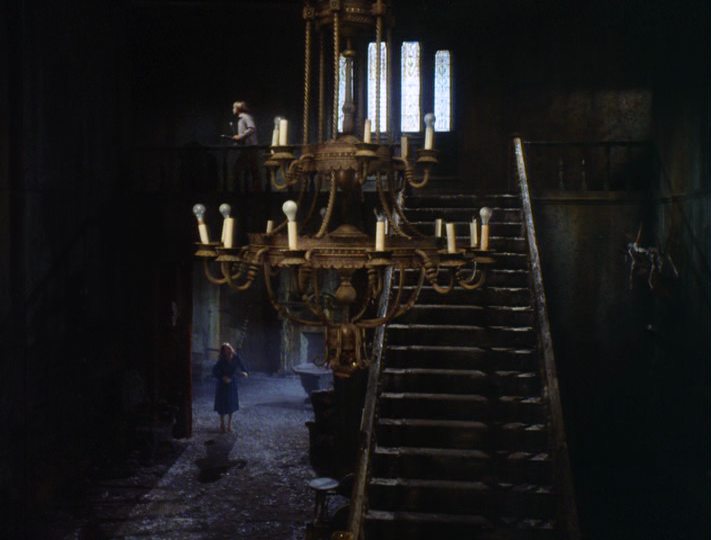
An earthquake-like tremble suddenly shakes the funhouse and the incongruous chandelier of this funhouse "glass room" (that I don't believe we see during the course of the funhouse ride). We could have added the trembling chandelier when David in Spontaneous Combustion merely stands underneath to this post, in direct rhyme to this scene.
Showing posts with label Salem's Lot. Show all posts
Friday, July 14, 2017
Wednesday, December 14, 2016
Images and Feelings from 'Salem's Lot'
Near the closing of Hooper's Salem's Lot director's commentary, the director begins to spontaneously list off scenes that he is proud of, or fond of, probably in equal capacity. He mentions three scenes first, seemingly pulled from the top of his head, and then goes on to mention other, more typical scenes: Mike Ryerson being "mesmerized by the grave," the floating children, etc. Those first three scenes, though, one gets the sense are the scenes he really wants to point out. They are all relatively small scenes. These three scenes he first mentions are: Ben in the hospital (getting touched up by a nurse, having a serious conversation with Ed Flanders's Dr. Norton) after getting clocked by Ned Tebbets, "the lake" scene, and Ben and Bill Norton driving home from the funeral home after facing an undead Marjorie Glick.
Hooper gets his own sensibility.
These are all small scenes, but threaded with dark or hopeful tensions (tensions based in character), laced with odd formal decisions further underlining the tensions at play. One also gets the sense Hooper may have an underlying fondness for Ed Flanders's earnest, deeply morose stare and pool-like, soulful green eyes.
Hooper gets his own sensibility.
These are all small scenes, but threaded with dark or hopeful tensions (tensions based in character), laced with odd formal decisions further underlining the tensions at play. One also gets the sense Hooper may have an underlying fondness for Ed Flanders's earnest, deeply morose stare and pool-like, soulful green eyes.
The third scene, Ben and Bill Norton's ride home from the mortuary, contains one of Hooper's favorite moves for referring to the artifice of cinema - the car set piece and characters' interaction with unseen traffic - and for embodying the fierce presentational aspect of cinema meaning and artistry. This is just as the story is intensifying, as the vibrating tremors of imminent and perceivable danger have finally entered the picture. David Soul and Ed Flanders's inchoate back-and-forth in this scene is interrupted by an almost head-on collision, as if something was telling them to stop, as if human experience and the machinery of the world was at a permanent disjunction.
No wonder Hooper is such an advocate of character, because his form is so heavily dependent on our empathy.
Labels:
Salem's Lot
Saturday, August 10, 2013
THAS: The House of Great Decision and Governing Fear
Immense. Portraits of fear. Crane shots of decision.
Movements. Distance to foreground. Over and over. A movement mockery, the pull and trajectory of decision manifested in cinema. A mournful toying, the bleak redundancy of the movements, forward, back, to and fro, what's behind you and before, at your feet and creaking the floorboards above you, a Sisyphean boulder: fear and our endless state of decision.
The camera and the crane is both fate and decision. It is both Rube Goldberg (by way of accidentally toppled knickknack, collapsing flue, scuttling rats, creaking floorboards) and Susan finally "meeting the man she came here to meet."
Her dance with the camera - multiple times does she twirl in relation to us, and her migration through the manse is a three-step progression - endows grace and form, in other words a compassionate sense, to subtle suffering. The chimney's expiration of dust is a moment of pure dance, cinema as dance.
The sequence is a complex and interconnected series of shots. It is a cinematic poem: the constantly enclosing repetition of movements (of both Susan and the camera; Susan is literally made to move in a circle) is the unifying meter, its conveyance of a terrible existential state the eloquent rhyme. The sequence is unpredictable. The patterned jumping camera both jumps closer and jumps away at different, alternating times. Movements are foreseen, but subverted in equal measure as they are conventionally built up to, suggesting Hooper's critical art. This sequence is not here to scare or impress. It is why one of its most stylish push-in shots is subverted by Susan simply crossing it. Like a poem, it does not exist for any narrative satisfaction. It is communicative about plight. Not impressive, it is complexly meaningful.
* * *
Labels:
as aesthetic object,
as poetry,
Salem's Lot
Subscribe to:
Posts (Atom)