Sunday, February 26, 2012

François Truffaut on Nicholas Ray, From 'A Wonderful Certainty,' François Truffaut

(First published as 'L'Admirable Certitude,' Cahiers du Cinéma 46, April 1955, under pseudonym Robert Lachenay)
"The hallmark of Ray's great talent resides in his absolute sincerity, his acute sensitivity. He is not of great stature as a technician. All his films are very disjointed, but it is obvious Ray is aiming less for the tradition and all-round success of a film than at giving each shot a certain emotional quality. Johnny Guitar is 'composed,' rather hurriedly, of very long takes divided into four. The editing is deplorable. But the interest lies in elsewhere: for instance in the very beautiful positioning of figures within the frame. (The posse at Vienna's is formed and moves in V-shape, like migratory birds.)

Nicholas Ray is to some extent the Rossellini of Hollywood, in the kingdom of mechanization he is the craftsman, loving fashioning small objects out of holly wood. Hence a hue and cry against the amateur! There is not one of Ray's films without nightfall. He is the poet of nightfall, and in Hollywood everything is permissible, except poetry. Hawks, for instance, keeps it at arm's length, and Hitchcock cautiously ventures four or five shots each time, in small doses. While a Hawks settles down in Hollywood... and takes things easy, flirting with tradition all the better to flout it, and always winning, Ray is incapable of 'doing a deal' with the devil and turning the arrangement to his advantage - he is picked on and loses the battle even before he starts fighting.

Hawks and Ray perform an opposition much like Castellani and Rossellini. With Hawks we witness a triumph of the mind, with Nick Ray it is a triumph of the heart."
Hawks/Castellani/Carpenter, Ray/Rossellini/Hooper.

Tuesday, February 14, 2012

THAS: Did You Realize... #1 ('Lifeforce')

Did you realize...

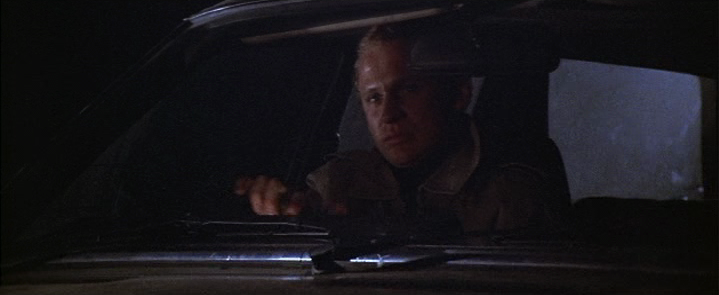
that the scene in 'Lifeforce' in which Carlsen (Steven Railsback) and Caine (Peter Firth) drive through the infection-ravaged streets of London is constructed out of a remarkable series of differentiated car shots?

Each constitute their own set-piece - almost an individual story of the character's experience and their ordeal - and perform each their own distinct tonal gymnastic, and Hooper manages to deliver in his very characteristic pursuit of relentless inspiration and unmitigated aesthetic creation and expression. (Note how the various textures of each shot's mise en scene - the framing, its tightness or distortion, and so on; the undulating lighting; the surrounding backdrop or absence of such in the car window(s) around them; and so forth - help express the "individual story"/"chapter" the shot puts forth.)

Each is equally or more strident than the last, Hooper's aesthetic craft devoted to sophisticated formal angularity and conscious irony rather than simple stylistic dazzle and placating sentimental conventions.


A Drive Through London
by Tobe Hooper


∫∫ In which Caine first charges readily into the ground zero of afflicted
London.


∫∫ In which Caine clearly acclimates to his new environment yet is still
startled by a loud noise.


∫∫ In which Caine is frazzled by a road kill but does not let it faze him.


∫∫ In which Carlsen drives through London irretrievably drawn by the
Space Girl.


∫∫ In which Carlsen suddenly brakes sharply as he is immobilized by the
thought of the Space Girl. -- Carlsen in a daze. -- A zombie arm. -- Carl-
sen rebukes himself for not keeping his wits about him due to sexy
thoughts.


(One of my favorite touches: the complete cutting off of the soundtrack during his elongated daze, the only accompaniment to his loss of wits the soft purr of the engine.)


∫∫ In which Caine takes in the atrocities of a burning London.


∫∫ In which Carlsen stops having spotted St. Paul's Cathedral. -- Carlsen
finds resolve.


∫∫ In which Carlsen still must drive through the nuisance of zombie hordes
before reunion with the Space Girl.


∫∫ In which Carlsen arrives at St. Paul's Cathedral with desires aflame.


∫∫ In which Caine comes to the last leg of his journey and arrives at the
Satellite Research Center.