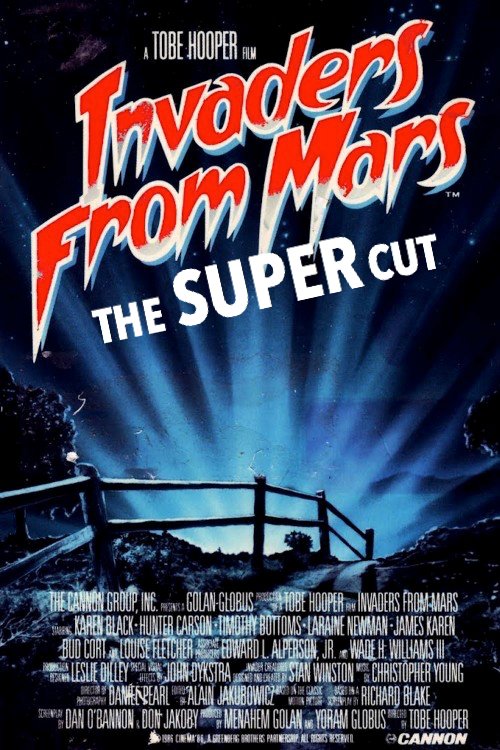
Experience Tobe Hooper's Invaders from Mars in a new way. An experimental one-to-one fusion of the theatrical version and the VHS-ripped rough cut that has made its way online here, this is hypothetical in many ways and something actually quite personal in others (the sharp-eyed fans of the film in its original form may notice a completely gratuitous cut made without any precipitation in the latter half of the film, and this was made only to exert some sort of power and predominance over the film, better to not confuse it for anything authorized or completely anyone's vision but my own - to the extent whatever that means).
It can ultimately be said that the best way to experience either Invaders from Mars or its rough cut are separately, as the rough cut gains (and earns) a quiet beauty by being raw and unmediated by post-production sound mixing and scoring, while the logy and lumpy pacing of Invaders from Mars by nature - one will notice, especially from watching the rough cut, that it's the rare Hooper feature that takes place explicitly over multiple days, laying out clearly its methodical passage of time (something I eventually argue is a thematic and philosophic point of the film) - becomes even more enervating when accommodating for the switching media.
I recommend all give it a chance, though, as it shows a film that was the original intent and that seemed to have had better grasp of the roiling ideas contained within it.
Watch it here: https://www.youtube.com/watch?v=S4USz5Whrq4
ACCOMPANYING TEXT TO 'INVADERS FROM MARS: THE SUPER CUT'
This is an unofficial experimental supercut combining Tobe Hooper's extant rough cut of the first hour and 19 minutes of the film and the full theatrical cut released by Cannon Films. The rough cut footage was taken from a VHS duplication of the director's in-progress cut, and thus reflects the video quality of the source. Rather than try to simply reinstate the larger deleted or altered sequences back into the movie in chunks, I frame by frame matched the two cuts and reconstructed every instinctual editing choice made in the rough cut phase, which ranged from the substantial to the miniscule. This was in order to present as closely as possible a "What Could Have Been" cut, that is, as if Hooper's initial desire of what his film would be actually made it to the screen.
Big thank you to those who've supported, cheerleaded, and those who viewed my initial demo of the film. Explicitly personal touches were added that one may or may not notice (the most suggestive of "creative liberties" more often than not involved sound work and musical choices). Acknowledgements to filmmaker Christofer Pallu for mostly suggesting to add sound effects for the outdoor radar device and the bold, cosmetic statement to chromakey Hooper's credit over the shot of the house, but also for his enthusiasm for the project and audio editing advice.
The frame by frame matching was actually a more necessary and complicated process than one would think, as the final cut exhibited not only deletions, but chronological reediting and swapped takes. Thus, take the following into consideration:
* scenes existing in the final film will appear here but in rough cut quality. This is most likely because entirely alternate takes were used in place of those initially incorporated.
* Shots may have been used in the final cut but utilized in a different capacity or at a different point. Thus, a "clean" final cut shot will be used momentarily within a scene that is by and large non-existent in the final cut.
* Scenes were restructured back to the original ordering and chronology of Hooper's rough cut.
* This is not even to bring up the scoring and sound work. The "personal" and "experimental" side comes up here, with musical workarounds used to change the tone of the film in the way I felt would have been closer to Hooper's primary intentions. The most glaring example would be the replacement of the opening credits theme used in the final cut with what is listed on the film's original soundtrack as "Original Intro and Main Title." In the process of constructing, it was discovered the cue known as "Original Intro and Main Title" was simply displaced, being not used in the opening titles, placed over the scene in which the parents put David to bed in its entirety as a soft, catch-all underscoring. Feeling this was an artificial rendering of the scene resultant of a utilitarian mindset - "if you got it/paid for it, use it" - and a desire to make the film play smoother, I used the rough cut audio in order to go without the scoring. Use of various cues from the original soundtrack recording is also done on occasion, particularly difficult as Christopher Young's score itself was subject to a similar sort of gutting, the film essentially scored twice - once by Young, a second pass, one of synthesizer atmospherics, by David Storrs - and so parsing what made it into the film and what didn't remains, even for me, after poring through the film for the last three months, incredibly difficult.
You can view the raw rough cut footage - before I tried to conform it to some level of theatrical presentation - or enjoy the Rough Cut as its own whole piece here: youtube.com/watch?v=S8JWWVOh91A&t=124s
A statement on the rough cut:
"... Clearer intentions are found in the more fragmented editing...
The rocket destruction scene is symptomatically reconstructed into a slack, Cannon spectacle in the Cannon cut... [which] eliminates dialogue and re-chronologizes the sequence... whereas here it's a fragmentary confusion of splintered world-views.
In its clearer demonstration of David as our proletariat hero... in its bolder assertion of time in the face of illusionary, dreamed spectacle, we see what Hooper truly intended. The intentions and placidity of the rough cut make are undeniably superior."
—————————————————————
Also included at my Vimeo is my 2020 recut of The Dark, directed by John 'Bud' Cardos, but with "contributions" by Tobe Hooper. It is one of my favorite films, and was even more of a labor of love than the Invaders from Mars recut. It removed all post-production tampering by the producers to turn it into an alien sci-fi film rather than the supernatural thriller it was intended to be.
"This re-cut of John 'Bud' Cardos's THE DARK involves no commercial interest, but, under fair use law, it does wish to rip the film away from the historic avarice of its producers and reclaim a vision that was much stronger than their misappropriation could ever be. So this isn't just for education, either - this is fair use under criticism/comment that involves piracy and smuggling, the only proper response to its producers... one of who, Edward L. Montoro, is actually a literal crook, absconding with an embezzled fortune to an equatorial region in the early 80s to never be heard from again.
"THE DARK: RECUT is not only a proper excising of studio/producer impositions but also partly a historical record of THE DARK, in particular, Tobe Hooper's role in it."
[End excerpt]"
"In the tradition of RAISING CAIN RE-CUT, THE DARK RE-CUT (2020) aims to restore the original integrity behind a film that some love, most simply have no thoughts about at all. But it’s the principle of the thing. In the year between THE DARK’s filming and its release in January 1979, producers, anticipating the release of Ridley Scott’s ALIEN and noticing the increasing popularity of “space” films from STARS WARS to CLOSE ENCOUNTERS, decided to turn what was a creature feature (one involving a monstrous entity stalking the LA streets and committing a murder every night, a monster of which our inability to explain was the very point of the original story) into a space invader flick, reediting every murder into an attack by an eye-laser-shooting alien using cheap opticals and superimposed stock explosions. Reshoots occurred to implement actual fire effects into the big monster showdown in the end, beginning and end titles imploring of the vastness of space were added, and the rest is history. In the end, even John ‘Bud’ Cardos, who didn’t even develop or work on the preproduction of the film - rather, it was developed by Tobe Hooper himself - was caught off-guard by this imposition by the producers. THE DARK (1979) is a rich text concerning the coexistence of clashing egos, the workings of civil society as a tapestry meant to function as a whole, the illusion of state protection, the nature of fear as a natural outgrowth of social constructs, and the idea of darkness as what hides yet contains that which we fear, so much as being a reminder of a state pre-consciousness and pre-society. This may not all come to fruition in the film that was ultimately removed from Tobe Hooper’s hands, but what remains or is sensed of his and John ‘Bud’ Cardos’s efforts deserves at least the saving from one of the most cynical and scornful moves in producership history.
THE DARK: RECUT is not only a proper excising of studio/producer impositions but also partly a historical record of THE DARK, in particular, Tobe Hooper's role in it.”