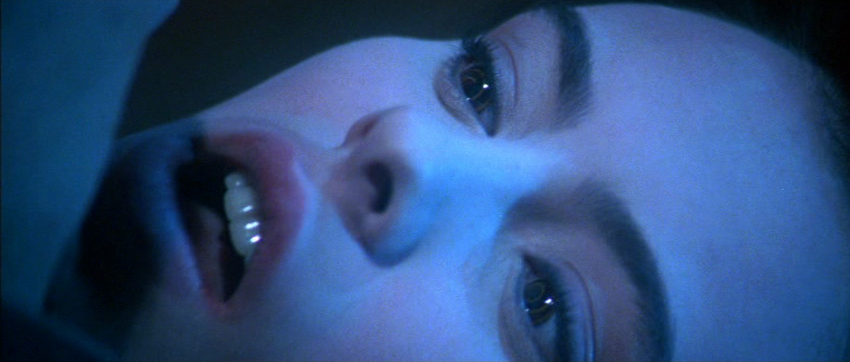
In which a breakage of madness, true and incontinent, sets off an outbreak of barely dormant madness around them.
Madness is in a constant threat of relapse for many - not just inhabitants of mental facilities - and it lies inactive only in the sense of a venereal disease and its cycles of outbreak and latency. But resounding first and foremost in the pitiable chorus of the mad is not the vulnerability, but the empowerment: the sense of the equality and permeability of the communicable condition. The medley of diverse screams and ravings from their comrades evokes both the diversity and the sameness - and the majority power.


In which passion is something internal: a physical displeasure. Sweats. Nausea. A shade across the eyes, sunken from the inside out. Being formed of blood, as all living things are. The sudden gangrenous quality of colors.


Hooper: 'Yeah, yeah... well, unless it is? Unless, unless... is that "love"? I mean, I know exactly what you're talking about, but I mean... I don't know... I mean, Citizen Kane. What's that song? [singing] "It can't be love..."'
Hooper does not continue singing it, but suffice it to say, it goes on in romantically dysfunctional fashion, like so:
"... because I feel so well.
No sobs, no sorrows, no sighs...


Hooper: "I guess it comes down to, you know, this kind of love, between human beings... You know, I mean, there's love... and that's, you know... it at least seems to fall into the realm of good. And I think that... what is that? What is love between two people, like this? Well, I mean, not like this! [referring back presumably to the relationship between Carlsen and the Space Girl] But I mean... [love] period?"


"This can't be love, I get no dizzy spells. My head is not in the skies."


Hooper: "Well, uh... that's either the truth, or a lie!"
The equivocality of Lifeforce.


(regarding his statement, "It's either the truth, or a lie!")
Hooper: "But, the last frame of the movie... [shows]... it's probably... it falls somewhere..."Sullivan: "In between?"
Hooper: "Yeah, in between."
Sullivan: "I mean, you know... are we all one of them?"
Hooper: "Or, you know, are we all the same thing?"


I recently watched Canadian/Québécois filmmaker Denys Arcand's The Decline of the American Empire, released in 1986, which strikes me very much in the same way Lifeforce does: a liberated, all-things-fair-game survey and depiction of a sexual living. Tackling such 80s-zeitgeist standards-of-happiness such as bourgeois intellectualism and casual infidelity (Lifeforce takes on authority figures, professionals, and other such lives of sublimated spirituality), whilst questionably but forthrightly deflating or taking a pinprick to the solemn issue of disease and AIDS, The Decline of the American Empire, as does Lifeforce, tries to bring buoyancy and levity and wide, opened arms to an increasingly fraught topic, through a bracingly candid, almost clinically rhetorical, but otherwise scrupulous and humanly conscientious film. Lifeforce aims to clear all conceivable divides and tackle a fraught topic with a work of genre, but one with a scope of vision and a positive, conscientious buoyancy. As Lifeforce re-purposes sci-fi imagery into dizzying, vorticular, contorted landscapes of sexuality and passion (Hooper, paraphrased, speaking on the commentary about the shots on the green moors following Nancy Paul's Nurse Donaldson, cruising wide open nature in a rain poncho: "And this is like from Far from the Madding Crowd!"), similarly does The Decline of the American Empire wittily takes women's hardcore exercises and a gaggle of men in the kitchen and visually conflates those activities with their varied sexual topics of discussions.


 "I'm gonna have to force her to tell me. Despite appearances, this woman is a masochist. An extreme masochist."